
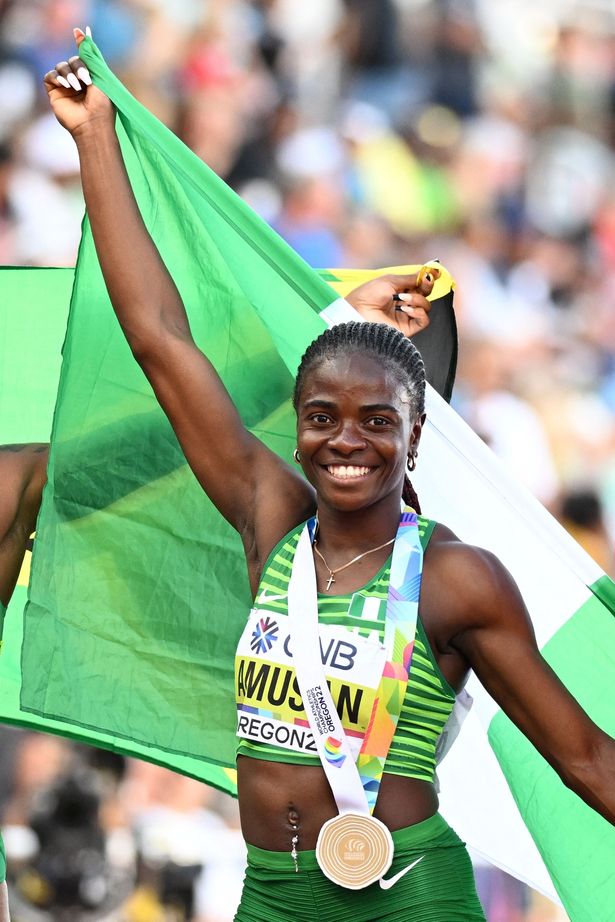

How a girl from Ijebu Ode who once dreamed of football became the fastest 100m hurdler the world has ever timed. The stadium holds its breath. Tobi Amusan crouches into the blocks for a 100m hurdles semifinal. Nobody expects history. Not yet. She explodes off the line. Ten hurdles blur past beneath her. The clock stops at 12.12s. A world record, set in a semifinal, hours before the final has even started. Officials scramble to confirm it. The scoreboard flashes red, then locks in. The crowd roars, but Amusan barely reacts. She still has a final to run that same night. That single race changed everything. It turned a determined Nigerian sprinter into the fastest hurdler in history.
However, the story behind that 12.12 didn’t begin in Oregon. It began nine years earlier, on a dusty track in Ijebu Ode.
The Journey of Tobi Amusan From Ijebu Ode to Texas
See also: http://Novaline.com.ng
Tobi Amusan was born on April 23, 1997, in Ijebu Ode, Ogun State. She was the youngest of three children. Both of her parents worked as school teachers. As a girl, she wanted to play football, not run track. Her father doubted a career in sports made sense. Still, he came around once he saw how serious she was. She attended Our Lady of Apostles Secondary School in Ijebu Ode. Coaches noticed her raw speed early. In 2013, she won silver in the 200m at the African Youth Championships in Warri. A year later, she switched to hurdles. The move paid off almost instantly. By 2015, at just 18, she won gold in the 100m hurdles at the African Junior Championships in Addis Ababa. Soon after, she added another gold at the All-Africa Games.
Those results opened a door to America. The University of Texas at El Paso offered her a scholarship, and she left home to chase something bigger. She didn’t waste the opportunity. In 2016, as a freshman, Amusan broke the 13-second barrier for the first time, clocking 12.83s. That run shattered a UTEP record that had stood for 33 years. The same year, she reached the semifinals at the Rio Olympics. Clearly, the Nigerian sprinter was only getting started.
Breakthrough Moments and World Record Drive
By 2018, Amusan had turned potential into hardware. She won gold at both the Commonwealth Games and the African Championships that year. Meanwhile, her technique between the barriers grew sharper with every season. Three years later, she claimed her first Diamond League title. As a result, expectations around her started to shift. Each race, she looked a little closer to something historic.
Then came Eugene. On that July night in 2022, Amusan ran the stunning 12.12s semifinal that broke the existing world record. Hours later, she returned for the final and ran even faster, clocking 12.06s. Officials ruled the tailwind too strong to certify that second time. Even so, her 12.12s mark from the semifinal stood untouched. She won gold that night, too. Consequently, Amusan became the first Nigerian athlete to win an individual World Athletics Championship title. Back home, the celebration was instant and enormous.
Nigeria’s first world champion in track and field wasn’t born from luck. It came from a decade of quiet, patient work.
Later that year, Amusan defended her Commonwealth Games crown in Birmingham. She also won the African Championships again. However, Nigeria’s 4x100m relay squad later lost its medal after a teammate failed a doping test. Amusan’s individual results stayed untouched by that separate case.
More Than a Hurdler: Education and Preparation
Amusan never treated athletics as her only pursuit. She earned a degree in health promotion from UTEP in 2019. In 2023, she added a master’s degree in leadership and sports management from the same school. Her coaching team reflects that same discipline. Lacena Golding-Clarke and Mika Laaksonen guide her technical work abroad. Back home, she trains with the Buka Tigers under coach Solaja Ayodele.
Fans and teammates call her “Tobi Express,” and the nickname fits well. Beyond the hurdles, she has also clocked 11.10 seconds in the flat 100m and 22.66 in the 200m. That raw speed explains why she covers the barriers so explosively. Adidas sponsors her career today, while Icon Management handles her business affairs.
Overcoming Adversity: The Toughest Fight For Tobi Amusan
Success rarely arrives without obstacles. For Amusan, the toughest one landed just weeks before she planned to defend her world title. In July 2023, the Athletics Integrity Unit charged her with missing three doping tests within twelve months. The charge triggered an immediate provisional suspension. Amusan denied any wrongdoing right away. “I am a clean athlete,” she wrote on social media, insisting she had faced more testing than most competitors. She vowed to fight the charge before a tribunal, hoping for a resolution before the World Championships in Budapest.
Her case moved fast. Just weeks later, a disciplinary tribunal cleared her by majority decision. The suspension lifted immediately, and she competed in Budapest as originally planned. The saga wasn’t finished, though. The Athletics Integrity Unit appealed the ruling to the Court of Arbitration for Sport. Consequently, uncertainty hung over her career for nearly a year afterward.
Vindication and a Return to Form
The Court of Arbitration for Sport finally ruled in June 2024. It dismissed the appeals from both the Athletics Integrity Unit and the World Anti-Doping Agency. Judges confirmed that Amusan had committed no anti-doping violation. That decision cleared her path to the Paris Olympics that same summer. Despite the long fight, she had stayed focused on training throughout the ordeal. Later that year, she added another African Games gold medal to her collection.
Looking back, the case tested more than her legal team. It tested her mental resilience under intense global scrutiny. Still, she emerged with her reputation, and her world record, fully intact.
Legacy, Impact, and What Lies Ahead
Tobi Amusan’s world record still stands today. Nobody has run the 100m hurdles faster than 12.12s. That mark alone secures her place in athletics history. Beyond the record, though, her consistency stands out just as much. She has won three consecutive Diamond League titles and three African Championships crowns. Add two African Games gold medals, and the résumé speaks for itself.
In 2026, Amusan is chasing something new again. She currently sits second in the Diamond League standings, just behind American rival Masai Russell. Meanwhile, she has already qualified for September’s Diamond League Final in Brussels, aiming for a fourth overall title. She is also chasing a third consecutive Commonwealth Games title, this time in Glasgow. No woman has ever won three straight golds in this event before. If she pulls it off, it becomes yet another first for her country.
For young Nigerian athletes, her story carries real weight. Amusan proved that African sprinters can rewrite record books on the biggest stages. She also proved that setbacks, even serious ones, don’t have to define a career. Whatever unfolds in Brussels or Glasgow, her legacy is already secure. Tobi Amusan didn’t just break a record that night in Eugene. She changed what Nigerian athletics could look like for an entire generation.