
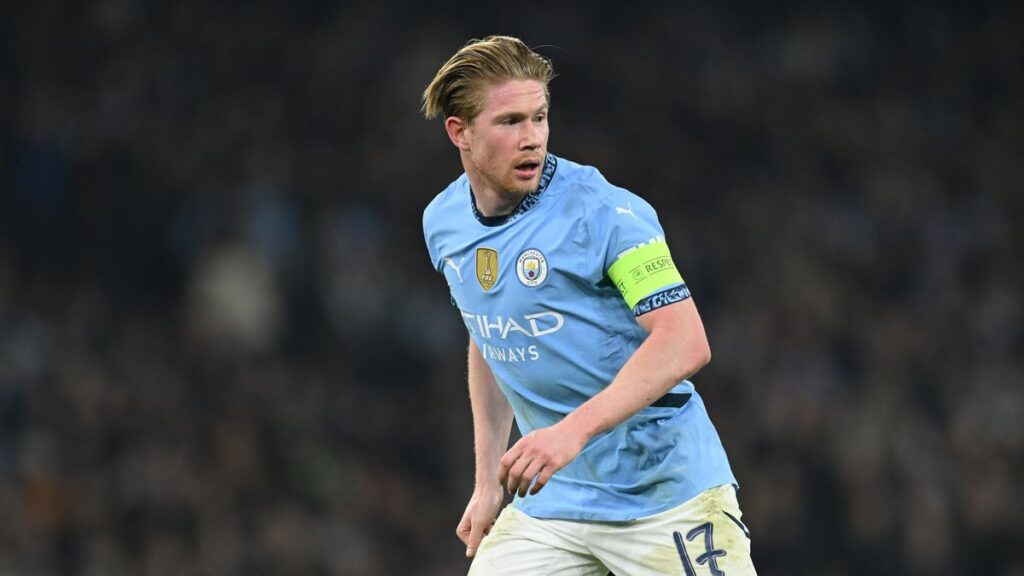

Few footballers change the way a generation understands the game. Kevin De Bruyne is one of them. For over a decade, his passing range, vision, and relentless work rate have set a standard that few midfielders come close to matching. Consequently, fans and pundits alike often describe him simply as one of the greatest playmakers of his era.
This biography traces the full journey of Kevin De Bruyne, from a quiet Belgian town to the biggest stages in world football. Along the way, we explore his early struggles, his rise at Manchester City, his leadership for Belgium, and the legacy he continues to build today. Above all, his story proves that patience and self-belief can outlast even the harshest setbacks.
Biography of Kevin De Bruyne
See also: http://Novaline.com.ng
Kevin De Bruyne was born on 28 June 1991 in Drongen, a quiet town near Ghent, Belgium. He stands 1.81 metres tall and plays as an attacking midfielder, though his versatility allows him to operate across the entire midfield line. Currently, Kevin De Bruyne represents Serie A club Napoli, wearing the number 11 shirt.
His playing style blends elite vision with pinpoint passing and fierce competitiveness. Furthermore, his ability to read space before defenders react has become his defining trait. Coaches consistently praise his intelligence, and teammates rely on his creativity to unlock stubborn defenses. As a result, Kevin De Bruyne has become a name synonymous with modern midfield excellence.
Early Life and Childhood
Kevin grew up in a disciplined household. His father, Herwig De Bruyne, worked in business, while his mother, Anna, built a career as a petroleum engineer with family ties stretching across Belgium and East Africa. Because his mother had lived abroad, she encouraged Kevin to learn several languages early. This skill later helped him settle quickly whenever he moved to a new country.
Football entered his life at just four years old. He started kicking a ball around Drongen long before anyone predicted his future. Meanwhile, his family often spent holidays abroad, giving young Kevin a broader worldview than many of his peers. Even then, teachers and neighbours noticed his stubborn determination whenever he competed in local games.
Childhood
His childhood was not glamorous. Instead, it was built on repetition, homework, and hours spent perfecting his first touch. Despite this modest beginning, his hunger to improve never wavered. That hunger, more than raw talent alone, is what eventually carried him toward professional football.
Youth Career of Kevin De Bruyne
De Bruyne’s youth journey began at KVV Drongen in 1997. Two years later, he joined Gent’s academy, where coaches sharpened his technical foundation. In 2005, Genk’s youth setup recruited him, recognising a rare blend of composure and creativity.
At Genk, his development accelerated. Coaches pushed him toward the first team, and his hard work paid off with a senior debut in May 2009. Although his introduction came in a defeat, his talent was undeniable. Subsequently, he broke into the starting lineup and never looked back.
By the 2010–11 season, Kevin De Bruyne was already influencing results at senior level. He recorded five goals and sixteen assists as Genk claimed the Belgian league title. This breakthrough season confirmed what scouts across Europe had begun to whisper: a special player was emerging from Belgian football.
Professional Career
Genk Career
De Bruyne’s spell at Genk established his reputation as Belgium’s brightest young prospect. His passing range stood out immediately, and his goal contributions kept climbing. In October 2011, he scored a hat-trick against Club Brugge in a thrilling 5-4 victory. Moments like this convinced bigger clubs to take notice.
Chelsea Journey
In 2012, Chelsea signed Kevin De Bruyne, hoping to develop him into a long-term first-team option. However, opportunities under manager José Mourinho proved limited. Because first-team minutes were scarce, De Bruyne struggled to make a lasting impact in England during this period. Even so, the experience taught him valuable lessons about elite-level competition.
Werder Bremen Loan
To gain regular playing time, De Bruyne joined Werder Bremen on loan during the 2012–13 season. There, he flourished in the Bundesliga, showcasing his creativity on a bigger stage. This loan spell reignited his confidence and reminded scouts of his enormous potential.
Wolfsburg Success
Chelsea sold him to Wolfsburg in 2014, and the move transformed his career. At Wolfsburg, De Bruyne delivered one of the most productive midfield seasons in Bundesliga history. He recorded 16 assists in a single campaign, a tally that still earns admiration today. Consequently, Wolfsburg’s German Cup triumph owed heavily to his creative influence.
Manchester City Journey
In 2015, Manchester City signed Kevin De Bruyne from Wolfsburg for a club-record fee at the time. What followed was a decade of dominance. Under Pep Guardiola, he evolved into arguably the finest passer in the Premier League. His numbers back this up: over 400 appearances, more than 100 goals, and a Premier League assists record chase that placed him among the competition’s all-time greats.
Trophies
City’s trophy cabinet expanded dramatically during his tenure. He won six Premier League titles, one UEFA Champions League, two FA Cups, five League Cups, and multiple domestic Community Shields. Above all, his Champions League triumph in 2023 completed City’s historic treble, cementing his status as a club legend. In April 2025, he announced his departure, closing an emotional chapter in Manchester. That summer, Kevin De Bruyne joined Italian giants Napoli on a free transfer, choosing a fresh challenge over a quiet retirement path. Despite an injury-affected debut season in Serie A, he remained determined to prove his class in Italian football.
International Career of Kevin De Bruyne
Kevin De Bruyne made his senior Belgium debut in 2010, joining a national team on the verge of a golden generation. Since then, he has become one of Belgium’s most influential players, eventually earning the captain’s armband. His creativity helped Belgium reach the semifinals of the 2018 FIFA World Cup, their best finish in decades.
At the European Championships, De Bruyne consistently delivered composed performances under pressure. Meanwhile, his leadership qualities grew alongside his experience, and younger teammates began looking to him for guidance. By the time Belgium qualified for the 2026 FIFA World Cup, De Bruyne had firmly established himself as the squad’s veteran anchor. Although injuries and age have tested him in recent seasons, his tactical intelligence continues to guide Belgium’s midfield structure.
Playing Style
Vision defines Kevin De Bruyne more than any other trait. He consistently spots passing lanes that most players never notice. Additionally, his weight of pass allows teammates to receive the ball in stride, creating instant attacking momentum.
His versatility adds another dimension. He can operate as a deep-lying playmaker, a wide creator, or an advanced attacking midfielder. Because of this flexibility, managers have deployed him in multiple roles throughout his career without diminishing his effectiveness. Furthermore, his leadership on the pitch often lifts teammates during difficult matches.
Physically, he combines stamina with sharp decision-making under pressure. Even when marked closely, he finds ways to escape defenders through clever body positioning. As a result, many pundits regard Kevin De Bruyne as one of football’s most complete modern midfielders.
Personal Life of Kevin De Bruyne
Away from football, Kevin De Bruyne leads a private but grounded family life. He met his wife, Michèle Lacroix, in 2014, and the couple married in Italy in 2017. Together, they are raising three children, who occasionally appear alongside him during public celebrations.
De Bruyne values discipline outside football too. He rarely courts controversy, preferring to let his performances speak for themselves. In addition, he has supported charitable causes connected to Special Olympics, reflecting his mother’s influence and his own sense of social responsibility. Despite his fame, those close to him often describe him as reserved and family-oriented.
Net Worth
Financial analysts estimate Kevin De Bruyne’s net worth at roughly $80 million to $100 million as of 2026. This wealth stems primarily from his lucrative Manchester City contracts, where he earned among the highest salaries in the Premier League. His move to Napoli brought a reduced but still substantial salary, reflecting a natural transition into the later stages of his career.
Endorsements have also boosted his fortune significantly. Nike remains his primary boot and apparel sponsor, while EA Sports has featured him prominently across its football gaming franchise. Moreover, De Bruyne has diversified his income through investments, including stakes in esports and property. Ultimately, his financial success mirrors the consistency he has shown on the pitch.
Awards and Achievements of Kevin De Bruyne
Kevin De Bruyne’s trophy collection reflects sustained excellence at the highest level. He has won six Premier League titles, the UEFA Champions League, two FA Cups, and five League Cups with Manchester City. Additionally, he claimed the Belgian league title early in his career with Genk and a German Cup with Wolfsburg.
Individually, he has twice won the Premier League Player of the Season award, joining an exclusive group of players to achieve this feat. Furthermore, he has featured repeatedly in PFA Team of the Year selections and UEFA’s Champions League squad of the season. Beyond trophies, his assist numbers throughout his Premier League career rank among the highest ever recorded, underscoring his generational creative influence.
Interesting Facts About Kevin De Bruyne
Long before global fame, Kevin De Bruyne launched a clothing line named after his initials, KDB, donating a share of proceeds to Special Olympics. He also served as an ambassador for the 2014 Special Olympics European Games held in Belgium, a cause close to his family.
His family history stretches beyond Belgium, with maternal roots connected to East Africa. This background shaped his early love of travel and languages, skills that later eased his transitions between England, Germany, and Italy. Interestingly, despite growing up far from football’s traditional powerhouses, he became one of only five players to win the Premier League Player of the Season award twice, alongside legends like Cristiano Ronaldo and Mohamed Salah.
Legacy
Kevin De Bruyne’s influence extends well beyond individual statistics. He helped redefine the deep-lying playmaker role, proving that vision and passing range could dominate matches as much as pace or physicality. Consequently, young midfielders across Europe now study his positioning and decision-making as a blueprint for modern creativity.
His impact on Belgian football is equally significant. Alongside teammates from his generation, he helped elevate Belgium into a genuine world power, culminating in their 2018 World Cup semifinal run. Even as his career enters its final chapters, his leadership continues shaping how younger Belgian players approach the international stage. In England, City supporters still regard him as one of the club’s greatest ever signings, a status few players earn so decisively.
Conclusion
From a small Belgian town to the grandest stages in football, Kevin De Bruyne’s journey reflects patience, resilience, and relentless self-improvement. Despite early setbacks at Chelsea, he rebuilt his career through hard work in Germany before becoming a defining figure at Manchester City. Meanwhile, his leadership for Belgium proved that consistency and humility can coexist with extraordinary talent.
Today, Kevin De Bruyne’s legacy is secure among football’s modern greats. His vision, creativity, and competitive spirit continue inspiring players and fans worldwide. Ultimately, whether remembered for his City trophies or his Belgian captaincy, Kevin De Bruyne’s story remains one of football’s most compelling modern tales.