
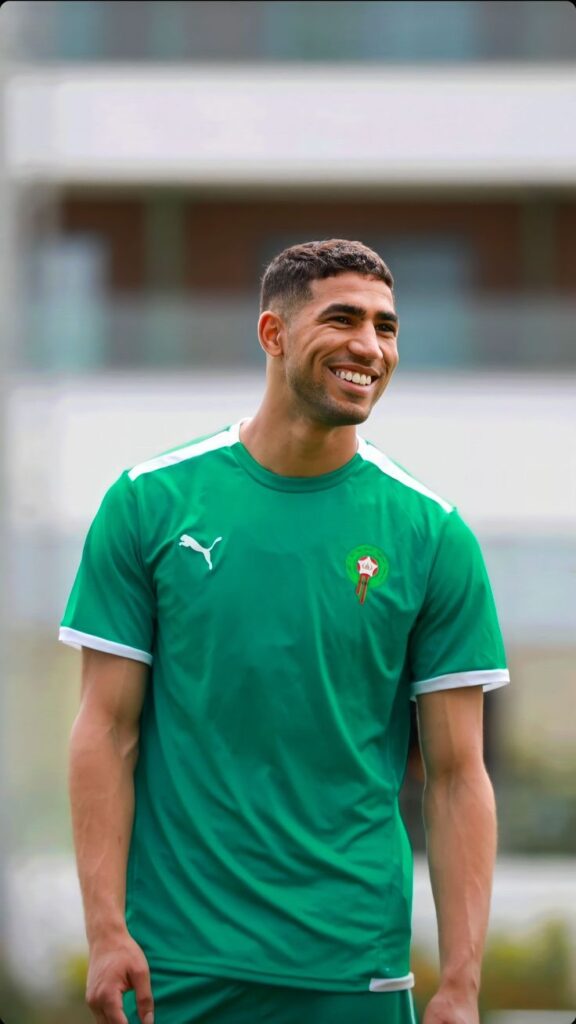

Achraf Hakimi rolls the ball down the middle of the goal. Unai Simón dives the wrong way. Within seconds, a stadium in Al Rayyan explodes, and a Madrid-born right-back sprints toward his mother in the stands. That single penalty, taken against the country of his birth, sent Morocco into a World Cup quarter-final. It also turned Achraf Hakimi into something bigger than a footballer. He became a symbol of a nation that had waited generations for this exact moment. Long before that night in Qatar, however, Hakimi was just another kid from a working-class corner of Madrid, chasing a ball down narrow streets. His story runs through three countries, four elite clubs, and one national team he chose with his heart instead of his passport.
Achraf Hakimi Growing Up in Getafe and Breaking Into La Fábrica
See also: http://Novaline.com.ng
Hakimi was born on November 4, 1998, in Madrid, to Moroccan parents from a village near Casablanca. His father sold goods on the street. His mother cleaned houses to help make ends meet. The family had settled in Getafe, an industrial district south of the Spanish capital, searching for a better life than the one they had left behind. Football gave young Achraf an early way out. At just eight years old, he joined Real Madrid’s academy, known locally as La Fábrica, after a short spell with a local youth side called Colonia Ofigevi. Inside that academy, Hakimi grew up speaking Spanish, Arabic, and eventually French, a mix of languages and cultures that later shaped how comfortably he moved between countries.
Progress at Real Madrid was steady rather than instant. He spent the 2016-17 season with Real Madrid Castilla, the club’s reserve team, playing 28 matches. His first-team debut arrived on October 1, 2017, against Espanyol. He scored his first senior goal that December against Sevilla. Even so, minutes remained scarce behind Dani Carvajal, and Hakimi still collected a Champions League winner’s medal in 2017-18 without ever becoming a regular starter.
The Dortmund Loan That Changed Everything for Achraf Hakimi
Real Madrid needed to find him playing time, so a two-year loan to Borussia Dortmund followed in the summer of 2018. Meanwhile, few people outside Spain knew much about the 19-year-old heading to Germany. That anonymity did not last long. At Dortmund, Hakimi was let loose. The Bundesliga’s attacking, high-tempo style suited his explosive pace perfectly, and he began bombing forward from right-back like a winger with defensive duties attached. In October 2019, he scored twice against Slavia Prague in the Champions League. A month later, he scored another brace, this time against his future club Inter Milan, turning a 0-2 deficit into a stunning 3-2 win.
By February 2020, Hakimi had become fast enough to set a Bundesliga speed record, hitting 36.48 km/h in a match against Union Berlin. Across two seasons, he racked up around 54 appearances, nine goals, and ten assists, plus a DFL-Supercup title in 2019. As a result, the player who left Madrid as a squad option returned to the football world as one of Europe’s most exciting young full-backs.
Inter Milan and a Serie A Title Under Conte
Real Madrid recalled Hakimi from loan, yet the club chose to sell rather than keep him. In September 2020, Inter Milan paid a reported fee of around €40 million to bring him to Italy. Instead of playing as a traditional right-back, Antonio Conte deployed him as a wing-back in a 3-5-2 system, a role built almost perfectly around his attacking instincts. The gamble paid off immediately. Hakimi scored seven goals and added several assists as Inter won the 2020-21 Serie A title, their first Scudetto in eleven years. His combination of recovery speed and end product made him nearly impossible for opposing wingers to exploit on the counter. Naturally, that kind of season at a major European club could not stay quietly priced for long.
Paris Saint-Germain and Global Stardom
In July 2021, Paris Saint-Germain paid a reported fee between €60 and €70 million for Hakimi, one of the largest transfer sums ever spent on a defender. At PSG, he settled into a squad packed with attacking talent, including Kylian Mbappé, and continued producing the kind of forward runs that had defined his career so far. Domestic success followed quickly, with Ligue 1 titles across multiple seasons. Still, the bigger prize took longer to arrive. In 2025, PSG reached the Champions League final in Munich, facing Hakimi’s former club, Inter Milan. PSG won, and Hakimi collected a second Champions League medal, seven years after his first as a fringe player at Real Madrid.
His game has matured, too. Where Dortmund-era Hakimi relied mostly on raw speed, PSG’s version reads pressing triggers earlier and times his overlapping runs with far more discipline. However, the core identity has barely changed. He still wants the ball in space, and he still wants to run at defenders rather than around them.
Morocco, the World Cup, and a Nation’s Breakthrough
Despite being born and raised in Spain, Hakimi chose to represent Morocco, the country of his parents. That decision looked inspired by the time the 2022 World Cup arrived in Qatar. Morocco reached the round of 16 against Spain, and after 120 goalless minutes, the tie went to penalties. Hakimi stepped up and chipped a nerveless Panenka down the middle, eliminating the nation of his birth. He then ran straight to his mother in the crowd, and the image of that embrace circled the world within hours. Morocco went on to beat Portugal in the quarter-finals, becoming the first African nation to reach a World Cup semifinal. France eventually ended the run, but the tournament had already rewritten what Moroccan football could achieve.
Since then, Hakimi has continued leading Morocco as they push toward the 2026 World Cup, carrying both the captaincy and the weight of a country’s expectations. Between his club trophies and his international achievements, he has become the most decorated African footballer in history, with roughly nineteen major team honors collected across four countries.
Final Whistle: What Makes Achraf Hakimi Different
Hakimi’s career rarely follows the predictable script of a modern full-back. Instead of settling into one system, he adapted to Zinedine Zidane’s Real Madrid, Lucien Favre’s Dortmund, Conte’s wing-back machine at Inter, and PSG’s star-studded frontline, thriving in each one. Meanwhile, off the pitch, he never distanced himself from where he came from, regularly crediting his parents’ sacrifices in Getafe for everything that followed. What stands out most, though, is the choice he made before any of the trophies arrived. He picked Morocco over Spain, family history over convenience, and that decision produced one of football’s most emotional World Cup moments. Few players manage to combine elite club success with that level of national meaning. Achraf Hakimi has done both, and at 27, his story is still being written.


