
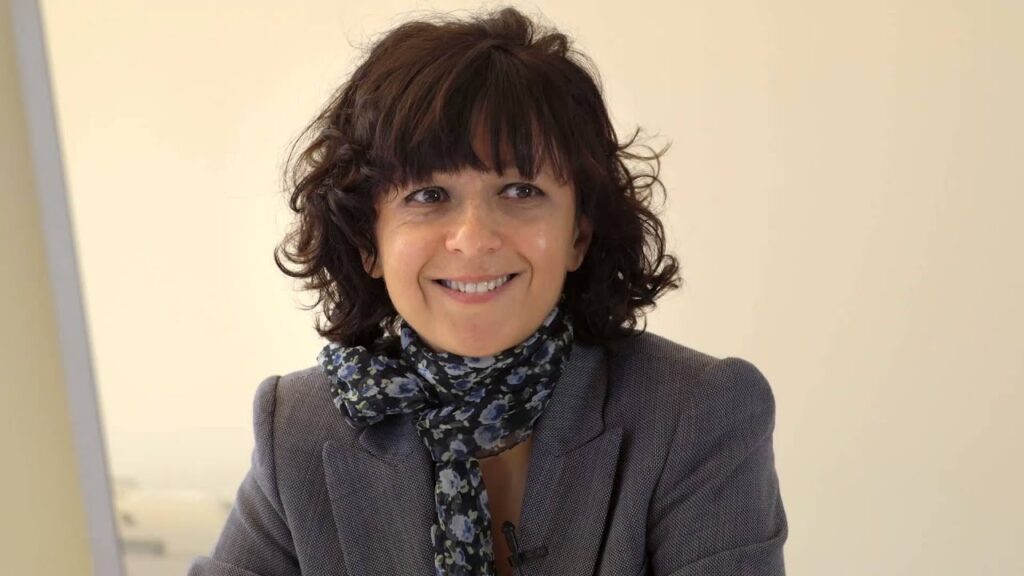

An Emmanuelle Charpentier biography told the way it happened: not as a résumé, but as a decades-long argument with borders, bacteria, and the limits of what a single laboratory notebook could hold.
The Promise a Twelve-Year-Old Emmanuelle Charpentier Made to No One in Particular
Emmanuelle Charpentier says she doesn’t actually remember saying it. However, her mother remembers the moment vividly.
She recalls an eleven-year-old girl coming home from school on an ordinary afternoon. With flat certainty, the child announced she would work at the Pasteur Institute one day. It was a bold claim about a future she could not possibly know yet.
Charpentier grew up south of Paris. In their household, her mother worked in psychiatry while her father planned the city’s green spaces. Ultimately, a biology lesson at school that week had lodged the institute’s name in her mind. Consequently, her mother wasn’t surprised decades later. When Charpentier finally chose the Pasteur Institute for her graduate research, her mother was already waiting for that sentence to come true.
A Bilingual Childhood of Science
See also: http://Novaline.com.ng
The house she grew up in ran on two very different registers of attention. For instance, her father liked to teach her the Latin names of plants. She later wondered if this habit first pointed her toward the natural sciences. Eventually, her mother’s interests bent that curiosity toward medicine.
As a result, this upbringing gave her an odd bilingualism before she ever left France. She absorbed the clinical vocabulary of the mind on one side of the dinner table. Meanwhile, she learned the taxonomic vocabulary of the garden on the other. In fact, she was drawn just as much to psychology, sociology, and philosophy as to pure science. She was a serious student, by her own account, but never a narrow one.
In 1986, she moved into Paris to study biochemistry, microbiology, and genetics at the University Pierre and Marie Curie. Six years later, the childhood promise came due. She walked into the Institut Pasteur as a doctoral student. There, she studied the genetic sleight of hand bacteria use to shrug off antibiotics. She stayed until 1995, leaving with a PhD and a quiet realization. Specifically, she felt she had outgrown the comfortable path lying directly in front of her.
A Scientific Nomad — Emmanuelle Charpentier
Staying in France, she has noted, was never really an option. It was impossible if she wanted her horizons to expand at the same rate as her curiosity.
Therefore, she wrote letters. She sent dozens of them to microbiology laboratories scattered across the United States. Most of these letters never received a reply. However, one lab did answer. It was the laboratory of Elaine Tuomanen at Rockefeller University in New York. Consequently, in 1996, Charpentier packed up her entire Parisian life. She moved to a massive city that owed her nothing.
Five Years of American Improvisation
What followed was less a rigid career plan and more a five-year improvisation. She navigated through several of New York’s top research institutions. She moved from Rockefeller to the New York University Medical Center, and then to the Skirball Institute of Biomolecular Medicine. Furthermore, she folded in a brief stint at St. Jude Children’s Research Hospital in Memphis.
During this time, she studied how Streptococcus pneumoniae rewires itself to survive tough antibiotics like vancomycin. Shortly after, she pivoted to hair-growth genetics in mice at NYU. She constantly chased whatever question was sharpest in front of her, rather than what looked best on paper.
Importantly, technique was not the only thing she took from those years. She also developed a taste for the American habit of collaboration. She appreciated letting a laboratory bump up against a biotech company without apology. At the time, her home country’s research culture rarely built such bridges.
|
City / Region |
Years |
Institutions |
|---|---|---|
|
Paris |
1986 – 1995 |
UPMC & Institut Pasteur |
|
New York |
1996 – 2002 |
Rockefeller · NYU · Skirball |
|
Vienna |
2002 – 2009 |
University of Vienna |
|
Umeå |
2009 – 2014 |
Umeå University, MIMS |
|
Berlin |
2015 – present |
Max Planck Society |
The Logistics of Relocation
After five years in the United States, she went back across the Atlantic. However, she did not return to France. Instead, she joined the University of Vienna in 2002 as a lab head and guest professor. While working with small regulatory RNA molecules in bacteria, she noticed something odd. A strange sequence sat near an unglamorous stretch of the bacterial genome.
Then, in 2009, she moved again. She relocated to Umeå, a university town in northern Sweden, to join the Laboratory for Molecular Infection Medicine Sweden. Each move had a specific reason attached to it. There was always a new technique to learn or a sharp question to chase. Nevertheless, she has been candid that mobility also handed her the unplanned parts of life. These are the breakthroughs you simply cannot get by staying still.
Of course, rebuilding a laboratory is not like packing a suitcase. Every single move meant re-hiring staff and securing new funding. She had to re-explain her research direction to entirely new review committees. This process reset in a new language and administrative culture each time. By 2015, when the German Max Planck Society recruited her to Berlin, Charpentier had completed this cycle four times.
Subsequently, she would do it once more inside Germany itself. She moved her group from Hannover to Braunschweig, and then to the Max Planck Institute for Infection Biology. Finally, she founded her own independent research unit in 2018. Colleagues who watched her work describe her as a woman running a controlled experiment on her own resilience.
Emmanuelle Charpentier: Decoding the Microbial Armor
Streptococcus pyogenes is not an exotic organism. It routinely causes strep throat, scarlet fever, and flesh-eating infections. It is the kind of pathogen every microbiologist eventually crosses paths with.
However, Charpentier’s version of that encounter began differently from most. Rather than studying the bacterium purely as a human threat, she looked closer. She went searching for the small RNA molecules floating around inside it. These regulators were too short to make headlines, but they were powerful enough to flip entire genetic programs on or off.
In 2004, working from Vienna, she published findings on one such RNA. This molecule was involved in switching on the bacterium’s virulence genes. It was patient, unglamorous work. It happened late at night in an empty lab, running gels long after everyone else had gone home. She spent hours waiting for a band to appear where theory said it should.
The Mystery of tracrRNA
One specific RNA refused to sit still in the tidy story she expected. It lived near an odd, repetitive stretch of DNA that geneticists called CRISPR. This stood for clustered regularly interspaced short palindromic repeats. Bacteria use this sequence almost like a mugshot file. It stores snapshots of viruses that attacked them in the past so the next attack can be destroyed.
At the time, nobody yet understood how one particular flavor of this system, known as CRISPR-Cas9, actually worked. In 2011, Charpentier’s lab published the answer to part of that mystery in Nature. This small RNA, which she named tracrRNA, was not a bystander. Instead, it was absolutely essential. It paired with the bacterium’s own CRISPR-derived RNA to guide the Cas9 protein to the exact piece of viral DNA that needed cutting.
What the CRISPR-Cas9 Discovery Actually Showed
- A trans-activating RNA (tracrRNA) pairs with CRISPR-derived RNA to form a dual-RNA guide.
- This dual-RNA guide directs the Cas9 protein to a matching DNA sequence.
- Cas9 then cuts the DNA at precisely that location in a programmable, repeatable way.
- Consequently, if you redesign the guide RNA, Cas9 can be pointed at almost any DNA target in any living organism.
That last point is the one that changed everything. A bacterial immune system had evolved over millions of years purely to fend off viruses. Yet, it turned out to be completely reprogrammable. It was no longer just a curiosity of microbiology. It was now a universal set of genetic scissors.
A Conversation That Outgrew a Conference
She met Jennifer Doudna at a scientific meeting in Puerto Rico in 2011. Doudna was an American structural biologist from Berkeley. Remarkably, Doudna was circling the same CRISPR system from a completely different angle. She was interested in the physical architecture of the Cas9 protein rather than the RNA choreography around it. The two women realized, over the course of one conversation, that their approaches interlocked perfectly.
The Transatlantic Collaboration
The geographical distance between them was significant. Charpentier’s lab sat in Umeå, on Sweden’s northern edge, while Doudna’s lab was in California. Despite this, they coordinated a major transatlantic collaboration. They worked via email, phone calls, and the occasional international flight. Soon, they folded two labs’ worth of data into a single, cohesive paper.
In August 2012, the journal Science published the historic result. The paper offered definitive proof that the dual-RNA-guided Cas9 system could be simplified. Researchers could use a single synthetic guide RNA to cut virtually any DNA sequence they chose.
Previously, gene editing required painstaking, custom-built protein engineering for every new target. Suddenly, the process became something closer to word processing. Scientists could simply find the sequence, guide the scissors, and make the edit.
Genetic Scissors, Handed to the World
The 2012 paper did not stay inside academic journals for long. In 2013, Charpentier co-founded CRISPR Therapeutics. The company was built to push the technology toward actual treatments for human disease, rather than leaving it as a distant laboratory technique.
Consequently, laboratories on every continent began adopting the tool almost immediately. They began editing genomes in plants, animals, and human cell lines. Genetics suddenly moved at a speed the scientific world had never seen before.
Global recognition arrived in waves. She received the Canada Gairdner International Award in 2016 and the Kavli Prize in Nanoscience in 2018. Finally, on a Wednesday in October 2020, the historic phone call arrived from Stockholm. Charpentier and Doudna were awarded the Nobel Prize in Chemistry. The citation honored them “for the development of a method for genome editing.” Notably, this was the first science Nobel ever awarded to two women working together without a male co-laureate.
Where Emmanuelle Charpentier Leads Today
Today, Charpentier balances multiple high-level leadership and scientific roles:
- Max Planck Unit for the Science of Pathogens, Berlin: She serves as the Founding and Managing Director of this independent institute, which she built from scratch starting in 2018.
- Humboldt University of Berlin: She maintains an active academic presence as an Honorary Professor.
- CRISPR Therapeutics: She continues to provide scientific advisory guidance to the biotechnology company she helped launch in 2013.
- Ongoing Research: She actively pursues deeper insights into RNA-mediated regulation and CRISPR biology in bacterial pathogens. This keeps her in the exact same territory that started with one stubborn RNA in Streptococcus pyogenes.
The Max Planck Unit for the Science of Pathogens is the institutional version of everything her career has argued for. It is a place built entirely around infection biology and genetic memory in microbes. Furthermore, it is led by someone who spent twenty years insisting that the answers worth having are rarely the ones sitting closest to home.
She still moves daily between granular, patient work and the enormous downstream consequences of her discovery. Today, medicine, agriculture, and basic science are being reshaped overnight. This transformation stems from a mechanism she once found half-buried near a repetitive stretch of DNA nobody thought mattered yet.
If you ask her what drives her now, decades past that early childhood promise, her answer remains remarkably consistent. It is a fundamental unwillingness to leave a strange result alone until she understands exactly why it happened.
Frequently Asked Questions About Emmanuelle Charpentier
What is Emmanuelle Charpentier known for?
She is globally recognized for decoding the CRISPR-Cas9 mechanism in Streptococcus pyogenes. Alongside Jennifer Doudna, she transformed this mechanism into a programmable gene-editing tool, earning the 2020 Nobel Prize in Chemistry.
Did Emmanuelle Charpentier really work at the Pasteur Institute?
Yes. She fulfilled her childhood ambition by completing her doctoral research in microbiology there between 1992 and 1995.
Which countries has her scientific career moved through?
Her academic journey is highly international. She has lived and worked in France, the United States, Austria, Sweden, and Germany.
What is the Max Planck Unit for the Science of Pathogens?
It is an independent research institute located in Berlin, Germany. Charpentier founded the unit in 2018 and continues to lead it as Managing Director, focusing on pathogen biology and RNA regulation.
Did Emmanuelle Charpentier start a biotechnology company?
Yes. She co-founded CRISPR Therapeutics in 2013 to actively translate the CRISPR-Cas9 genetic tool into real-world medical treatments for serious human diseases.


