
The Real Tom Cruise Mapother IV: The Boy Who Ran First
Before he became Tom Cruise, he was Thomas Cruise Mapother IV. He was a boy who rarely stayed in one place long enough to feel rooted.
The story of Tom Cruise’s early life is not one of destined stardom. Instead, it is a story of constant motion. His family moved frequently across the United States and Canada. Consequently, new schools became a routine part of his life.
New classrooms meant fresh introductions, unfamiliar faces, and another round of trying to hide his secret. He had a dyslexic childhood that made every page of text feel like an obstacle course. Therefore, this condition shaped more than his education. Indeed, it shaped the way he approached the entire world.
Adapting to a Difficult World
See also: http://Novaline.com.ng
Leonardo DiCaprio Biography: The Quiet Fury Behind Hollywood’s Most Elusive Star
Reading was exhausting for the young boy. For this reason, memorization became his survival tool. Observation quickly became his primary currency. He learned to absorb expressions, body language, and the natural rhythms of conversation. Long before audiences praised his screen presence, he was studying people because he had to do so.
Unfortunately, his childhood struggle extended far beyond school. Cruise has spoken openly about his father, Thomas Mapother III. He described his father as someone who could be intimidating, unpredictable, and even cruel. In fact, he once called him a “merchant of chaos.”
Whether one agrees with that portrait or not, the emotional imprint is difficult to ignore. Home was not always a sanctuary for him. Rather, it was often an unpredictable environment to navigate.
Developing Strange Talents
Children raised in instability often develop strange talents. For example, some children learn to become invisible. On the other hand, others become completely impossible to overlook. Cruise clearly chose the second path.
There is a relentless quality to nearly everything he does. Furthermore, interviews from different decades reveal the exact same pattern. You see preparation bordering on obsession, intense focus, and a physical discomfort with wasted opportunity. These habits feel less like celebrity eccentricities and more like adaptations forged early in life.
The Power of the Stage
His mother, Mary Lee, became his emotional counterweight. Following her divorce, the family faced severe financial hardship. However, she encouraged creativity rather than bitterness. Acting finally arrived almost accidentally through school theater.
|
Childhood Challenge |
Survival Adaptation |
|---|---|
|
Constant Moving |
Quick observation of new environments |
|
Dyslexia |
Memorization and reading body language |
|
Unstable Father |
Intense focus and hyper-vigilance |
For someone who struggled with written words, performance offered a completely different language. Fortunately, the stage rewarded commitment instead of spelling.
Years later, Cruise would credit specialized learning techniques, discipline, and repetition for his success. He used these tools to overcome many effects of dyslexia. Yet, the deeper lesson remained with him. Difficulty never disappeared from his story; it simply changed costumes.
Beneath the polished confidence still lives the boy who learned that standing still meant falling behind. Ultimately, that survival instinct never really left him.
Risk, Perfectionism, and the Evolution of Action
Hollywood initially sold Tom Cruise as just another pretty face. However, he quietly transformed himself into an institution. During the 1980s, films like Risky Business, Top Gun, and Rain Man established his stardom.
Many actors might have settled comfortably into that specific lane. Cruise kept moving forward instead. This shift was entirely strategic. Instead of allowing studios to define him, he increasingly became a producer with significant creative control.
Through his own production company, he helped steer major projects. He carefully balanced commercial appeal with technical ambition. That decision changed more than his career. Indeed, it influenced the evolution of the Hollywood blockbuster itself.
The Shift to Practical Filmmaking
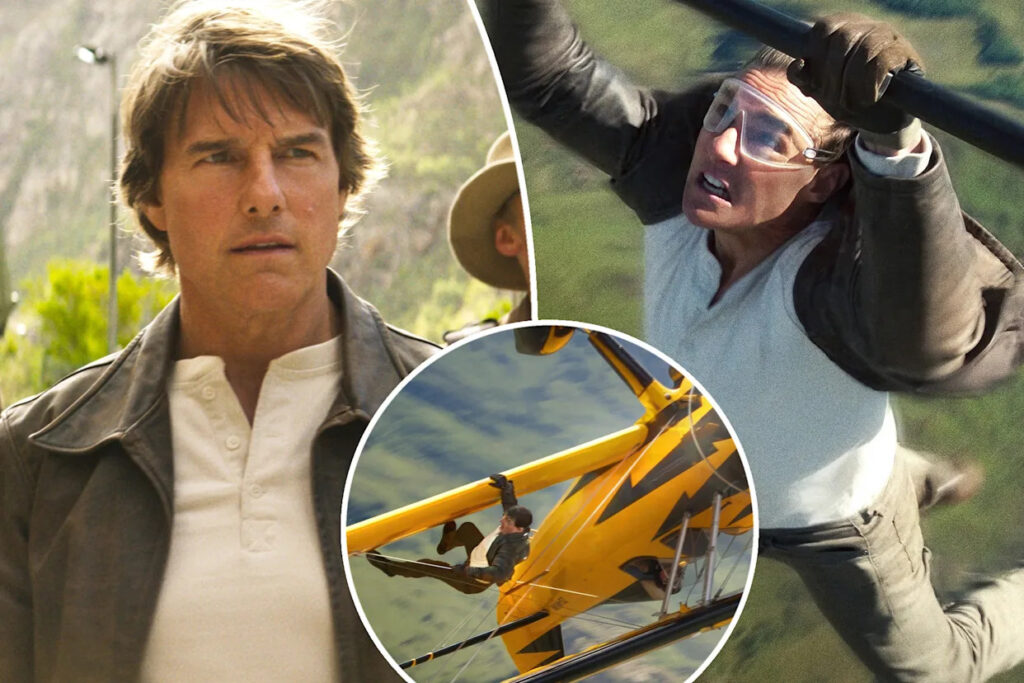
The Mission: Impossible series gradually abandoned heavy dependence on digital spectacle. Instead, the franchise favored practical filmmaking. At a time when computer-generated imagery became dominant, Cruise doubled down on physical reality.
- He hung from the side of an aircraft during takeoff.
- He scaled the outside of the Burj Khalifa.
- He learned advanced helicopter flying for stunts.
- He completed a motorcycle jump off a Norwegian cliff.
Each headline naturally focused on the immense danger. Nevertheless, the deeper question is why he did it. Why would one of the world’s most valuable movie stars repeatedly place himself in genuine physical jeopardy?
Part of the answer appears artistic. Cruise often speaks about audience trust. He believes viewers instinctively recognize authenticity, even when they cannot articulate why. Real momentum carries weight that visual effects still struggle to imitate. Thus, tiny imperfections convince the eye.
The Psychology of Perfection
Another layer of his motivation feels psychological. Perfectionism rarely arrives alone. In fact, it often travels beside anxiety. For Cruise, absolute preparation seems to quiet uncertainty.
He rehearses every stunt countless times until risk becomes a carefully managed calculation. The danger remains real, yet he reduces randomness wherever possible. There is almost an engineer’s mindset beneath the performer’s smile.
”His famous stunts are not reckless acts of bravado. Instead, they resemble elaborate negotiations with fear.”
This philosophy has left a lasting imprint on cinema history. Modern action filmmaking increasingly measures itself against practical execution rather than digital excess. Younger filmmakers frequently reference the renewed appreciation for in-camera spectacle that Cruise helped normalize again.
A Lasting Global Draw
His commercial value reinforces this point clearly. Few actors remain a genuine global box office draw across four decades. He survived changing audience tastes, streaming disruption, franchise fatigue, and multiple shifts in studio economics.
Cruise has repeatedly demonstrated that moviegoers will still buy tickets simply because his name promises commitment. He does not promise perfection. Rather, he promises pure commitment, and there is a meaningful difference between the two.
The Unseen Strains of the Hollywood Machine
Every public figure eventually becomes two distinct people. There is the actual person, and there is the public projection. Tom Cruise’s public persona has often overwhelmed the human being beneath it.
His smile became iconic across the globe. Likewise, his intensity became famous. For decades, he occupied an unusual position inside Hollywood stardom.
Collaborators known for demanding excellence admired him professionally. Simultaneously, he became one of popular culture’s most polarizing celebrities. The reasons for this divide are very familiar to the public.
Navigating the Public Spotlight
His outspoken affiliation with Scientology repeatedly drew criticism. He also criticized psychiatry and psychiatric medication during widely discussed television appearances. Furthermore, his exuberant couch-jumping moment on The Oprah Winfrey Show shocked fans.
His high-profile marriages and painful divorces kept him in the tabloids. Finally, reports noted his distance from his youngest daughter. Each episode fed a narrative that often reduced a complicated individual into a mere caricature.
Consequently, the off-screen controversy became easier to discuss than the work itself. However, that simplification misses something important. Living inside celebrity at Cruise’s level is profoundly unnatural.
The Hidden Cost of Fame
Imagine spending over forty years in a harsh environment. In this space, nearly every interaction carries financial incentives, public consequences, or strategic calculations. Trust becomes expensive.
Privacy becomes nearly mythical. Ordinary mistakes quickly become international entertainment. The inevitable result of this lifestyle is isolation. This is not necessarily physical isolation, but rather deep psychological isolation.
People often describe Cruise as relentlessly energetic, astonishingly polite, intensely prepared, and almost impossibly focused. Those qualities can inspire admiration while also creating emotional distance. The very traits that sustain extraordinary success may complicate ordinary intimacy.
Work as a Sanctuary
This is the hidden cost of immense fame. The Hollywood machine rewards consistency, but human beings require contradiction. Cruise has spent decades maintaining an image of constant forward motion.
Even during intense controversy, he rarely retreats for long. Instead, he returns to work immediately. He starts another production, tackles another impossible sequence, or begins another promotional tour.
One cannot know exactly what internal negotiations accompany that discipline. But it is difficult to watch his career without wondering whether work has become more than employment. Perhaps it has become his ultimate shelter.
Beyond the Franchise: Tom Cruise Embracing a Fearless Future
Many action stars spend their later careers protecting what audiences already love about them. In contrast, Tom Cruise seems increasingly interested in disrupting his own image.
His advocacy for theatrical exhibition has become one of the defining themes of his recent career. At a time when streaming fundamentally reshaped viewing habits, he repeatedly defended traditional theaters. He argued that certain films deserve the scale, sound, and communal electricity only cinemas can provide.
This commitment has made him one of Hollywood’s most visible theatrical experience advocates. This became especially true after the renewed emphasis on exclusive theatrical releases in the 2020s.
A Striking Creative Departure
The next chapter of his career may prove even more revealing. His 2026 movie, Digger, directed by Alejandro G. Iñárritu, represents a striking departure from his usual image. Early footage shown at CinemaCon revealed an almost unrecognizable Cruise beneath heavy prosthetics.
He portrays Digger Rockwell, an aging, deeply flawed billionaire whose own actions help unleash a massive catastrophe. Iñárritu described Cruise’s transformation as “another kind of fearless.” This suggests that emotional exposure, not physical danger, was the greater challenge this time.
|
Movie Era |
Primary Focus |
|---|---|
|
1980s – 1990s |
Star power and dramatic acting |
|
2000s – 2020s |
Practical stunts and blockbusters |
|
2026 (Digger) |
Emotional exposure and prosthetics |
The Iñárritu film matters precisely because it appears uninterested in preserving Cruise’s mythology. There are no motorcycles flying off cliffs in this project. You will see no perfect hair resisting hurricane winds.
Tom Cruise: Stripping Away the Vanity
Instead of the usual spectacle, audiences will see vanity stripped away completely. They will see age embraced rather than concealed. They will view failure worn openly across his face.
If the film fulfills that promise, it may become one of the most revealing performances of his career. That willingness to evolve speaks to something larger about the future of cinema. Tom Cruise has never merely chased relevance.
Instead, he has repeatedly changed the terms of the conversation. He did this through practical stunt work, producer-driven creative control, and championing theaters when much of the industry questioned their future.
The Persistent Mystery
He remains a fascinating contradiction. He is a global superstar who guards his private life with extraordinary discipline. He is a meticulous technician who still believes in pure instinct.
He is a man often criticized for his convictions, yet widely respected for his craftsmanship. After more than forty years under an unforgiving spotlight, the mystery persists. Perhaps that is the most revealing fact of all.
Tom Cruise has spent a lifetime allowing audiences to watch him fall from buildings. We watched him leap from aircraft, race motorcycles through impossible turns, and outrun explosions. Yet, the harder feat has always been something else entirely. He excels at keeping the real person behind the performance just out of reach.