
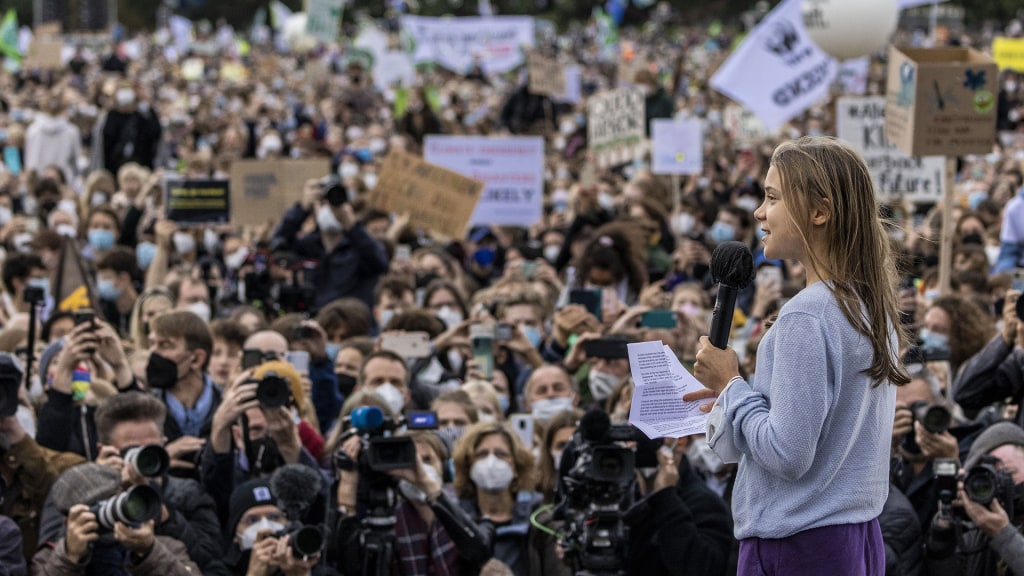

In August 2018, a fifteen-year-old Greta Thunberg sat alone on the cobblestones outside the Swedish parliament, holding a hand-painted sign that read “Skolstrejk för klimatet” (School strike for climate). Born on January 3, 2003, in Stockholm, Sweden, what began as her solitary protest quickly evolved into Fridays for Future—a global movement that shook the world’s most powerful leaders and redefined modern environmental activism.
The Early Life of Greta Thunberg and Her Quiet Awakening
Stockholm shaped her first eleven years in ordinary, unremarkable ways. Her mother, Malena Ernman, sang opera on Europe’s grandest stages. Meanwhile, her father, Svante Thunberg, came from a family of actors and artists. Greta, however, found her calling somewhere quieter than any concert hall.
At age eight, a school film about melting ice caps stopped her cold. She could not understand why adults seemed unbothered by the crisis. Consequently, she stopped eating properly and withdrew from friends and family. Doctors eventually diagnosed her with Asperger’s syndrome, along with OCD and selective mutism.
For years, this diagnosis felt like a private burden to carry. Later, Greta reframed it entirely, calling her autism a “superpower” rather than a limitation. It sharpened her focus and stripped away any patience for polite denial. As a result, she began reading everything she could about climate science.
How Greta Thunberg Ignited the Fridays for Future Movement
See also: http://Novine.com.ng
José Andrés: The Chef Who Turned Fire Into Hope for the World
By 2018, Sweden faced its hottest summer in over two hundred years. Wildfires tore through forests while politicians debated in air-conditioned chambers. Greta decided she could no longer sit quietly in a classroom. Instead, she skipped school and camped outside the Riksdag every single day.
Classmates thought she was strange; strangers thought she was invisible. Gradually, though, journalists began stopping to ask why a teenager sat alone. Her answer was simple and devastating: adults had stolen her future, so she demanded change. Photos of her spread across Swedish media within days.
Meanwhile, students in other countries began staging their own Friday strikes. Belgium, Germany, and Australia saw thousands of children walk out of school. By December 2018, the movement finally had a name: Fridays for Future. Never before had a single teenager’s protest scaled so quickly worldwide.
In March 2019, over one million students in 125 countries joined a coordinated strike. Suddenly, this shy Swedish girl represented an entire generation’s fury and fear. She never asked for fame, yet fame arrived anyway, loud and relentless. Nevertheless, she insisted the movement belonged to the students, not to her alone.
Confronting World Leaders: The Defining Speeches
Greta refused to fly, so she sailed across the Atlantic in a solar-powered yacht. Sixteen days at sea brought her to New York in August 2019. There, she addressed the United Nations Climate Action Summit with unmistakable fury.
“How dare you. You have stolen my dreams and my childhood with your empty words.”— Greta Thunberg, UN Climate Action Summit, September 2019
Presidents and prime ministers shifted uncomfortably in their seats as she spoke. Some praised her courage; others mocked her age and her intensity. Regardless, the speech traveled instantly across every major news network on earth. Her blunt honesty embarrassed diplomats who preferred careful, hedged language.
In contrast to typical summit rhetoric, she offered no diplomatic cushioning whatsoever. This directness became her signature, whether addressing Congress or the World Economic Forum. At Davos, she told billionaires their house was on fire, quite literally. Critics accused her of naivety; supporters called her the moral clarity adults lacked.
Beyond the Headlines: The Personal Cost
Global fame, unsurprisingly, arrived with a punishing personal cost. Trolls flooded her social media with cruel jokes about her autism. World leaders, including a sitting American president, mocked her publicly online. Meanwhile, tabloids scrutinized her clothing, her expressions, and even her sailing trip.
She later admitted the constant hostility sometimes left her exhausted and hollow. Still, she rarely responded with anger; instead, she leaned on dry humor. When insulted, she often updated her social media bio with the insult itself. This tactic disarmed critics and delighted her millions of young supporters.
Behind the composed public image, however, sat a genuinely private, soft-spoken person. Friends describe her as someone who prefers quiet walks over crowded galas. Therefore, she has repeatedly declined lucrative offers, interviews, and celebrity partnerships. Money, she has said, was never the point of any of this.
Her family paid a price too, absorbing threats and relentless media attention. Despite everything, Greta has refused every invitation to soften her message for comfort. That refusal, more than any single speech, defines her enduring character.
The Enduring Legacy and Future
Greta Thunberg is no longer the isolated teenager from that first Friday. She has grown into an adult activist with a widening set of causes. In recent years, she has joined flotillas attempting to deliver aid toward Gaza. Israeli forces detained her more than once during these missions, and she has publicly described the experience as frightening and abusive, though Israeli officials have rejected her characterizations and called the voyages political stunts.
Her critics argue she has strayed from her original climate focus entirely. Supporters counter that her worldview always linked justice, inequality, and environmental collapse together. Either way, she remains one of the most recognized activists of her generation. Fridays for Future chapters still meet in cities across the globe today.
Meanwhile, younger climate strikers now credit her as the spark that started everything. Her legacy, ultimately, is not a policy or a single speech. It is proof that one determined individual can shift a global conversation. Consequently, her story continues to remind us what stubborn conviction can achieve.
Frequently Asked Questions
What is Greta Thunberg known for?
Greta Thunberg is known for starting a solo school strike outside the Swedish parliament in August 2018, which grew into the global Fridays for Future movement demanding urgent climate action.
Does Greta Thunberg have Asperger’s syndrome?
Yes, Greta Thunberg has been diagnosed with Asperger’s syndrome, along with obsessive-compulsive disorder and selective mutism. She has described her autism as a superpower that sharpens her focus.
What did Greta Thunberg say to the UN in her famous speech?
At the 2019 UN Climate Action Summit, Greta Thunberg told world leaders “How dare you,” accusing them of stealing her dreams and childhood with empty promises on climate change.
What is Greta Thunberg doing now?
Greta Thunberg continues climate activism while also joining humanitarian flotillas attempting to deliver aid toward Gaza, broadening her focus to include humanitarian and justice issues.