
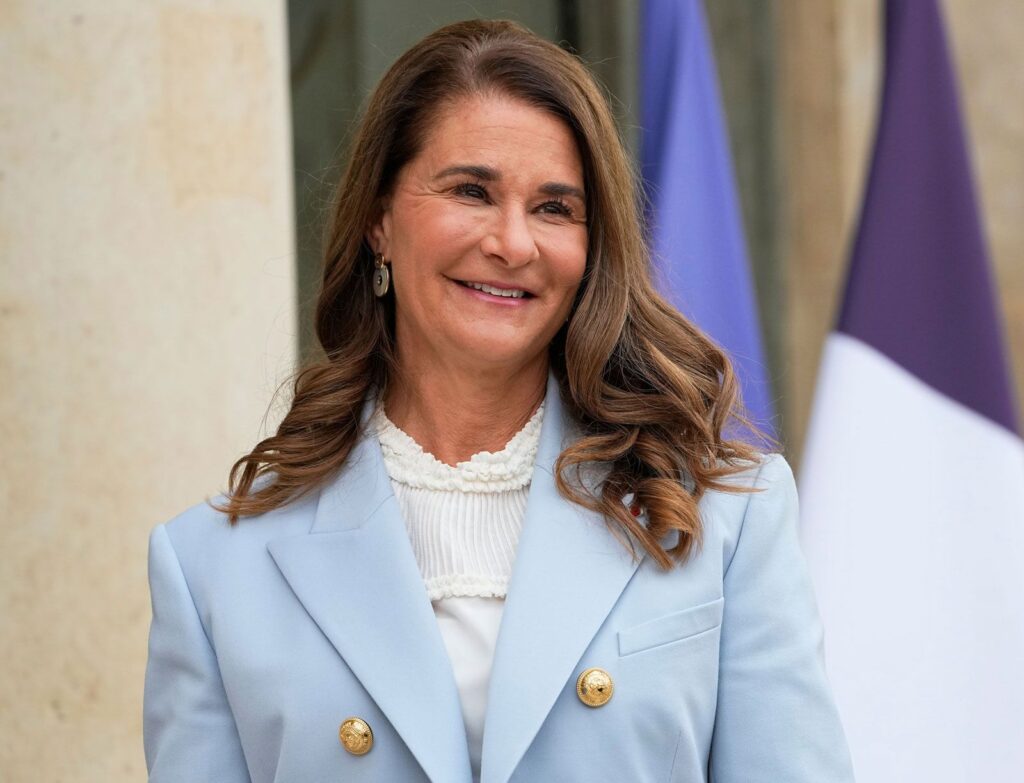

Melinda French Gates biography is simply summarized as product manager, a foundation co-chair, and now a founder who answers to no one but herself.
On a June afternoon in Tuscaloosa, Alabama, a woman sat on a couch with a stranger’s baby on her lap. This was not a local volunteer or a visiting nurse. It was Melinda French Gates, one of the world’s most powerful philanthropists, on a visit entirely her own. No husband sat beside her that day. Nobody reviewed her notes or questioned her budget. For the first time in nearly three decades of public life, every dollar in the room was hers to direct. That single visit captures her whole arc: a woman who built a career inside institutions, then walked out to build her own.Today, Melinda French Gates runs Pivotal, a sprawling network of funds, foundations, and advocacy arms she founded in 2015. She has committed more than $600 million to women’s health in the past two years alone. However, the dollar figures only hint at the deeper shift.
This is a story about agency, about spending decades sharing a microphone before finally picking one up herself. Her journey starts in Texas, long before Microsoft, long before the Gates Foundation, and long before Pivotal ever existed.
Early Life and Tech Roots
A Dallas Childhood Built on Discipline
Melinda Ann French was born on August 15, 1964, in Dallas, Texas. Her father worked as an aerospace engineer on the Apollo program, and her mother managed the household. Together, they ran a small rental property business on the side. Consequently, the French children spent weekends collecting rent and keeping the books. That early bookkeeping work introduced young Melinda to an Apple II computer. She was hooked almost instantly.
At Ursuline Academy, an all-girls Catholic school in Dallas, a teacher named Mrs. Bauer pushed hard for computer science education. Melinda seized the opportunity and taught herself BASIC programming. She graduated as valedictorian in 1982. From there, she enrolled at Duke University to study computer science and economics. Meanwhile, she interned at IBM during her final year of business school. Duke awarded her an MBA from the Fuqua School of Business in 1987. A formidable career was ready to begin.
Melinda French Gates Joins Microsoft
See also: http://Novaline.com.ng
The Fierce Voice of Freedom: The Human Journey of Malala Yousafzai
After graduation, IBM offered Melinda a job. She turned it down after a hiring manager told her, candidly, to consider a smaller and hungrier company instead. That company was Microsoft, and she joined in 1987 as a product manager. She was the only woman among ten new business hires that year. Nevertheless, she rose quickly, leading teams behind Encarta, Publisher, and the early version of Expedia. Her products required equal parts technical fluency and creative instinct, a combination she had been building since childhood.
It was at Microsoft that she met Bill Gates, the company’s young chief executive. They began dating in 1987 and married in 1994. Throughout the 1990s, Melinda rose to general manager of information products, overseeing a wide slate of consumer software. As a result, she developed a management style rooted in listening first and deciding second. That instinct would define the next chapter of her career far more than any product launch ever did.
The Foundation Era
Building the World’s Largest Foundation
In 2000, Melinda and Bill Gates combined earlier charitable efforts into the Bill & Melinda Gates Foundation. Within a few years, it became the largest private charitable organization on the planet. Melinda co-chaired the foundation for the next twenty-four years. She focused heavily on family planning, maternal health, and childhood immunization. Furthermore, she pushed the foundation to apply user-centered design, a discipline she had learned at Microsoft, to global health problems.
Her fingerprints showed up in unexpected places. For instance, she demanded that vaccine teams design around real mothers, not tidy bureaucratic charts. That approach helped cut global childhood deaths dramatically over two decades. Meanwhile, she traveled constantly, meeting mothers in rural clinics from Malawi to Bangladesh. Those visits, she has said, shaped nearly every strategic decision the foundation made afterward.
Melinda French Gates Confronts Global Disease
Global health work meant confronting difficult, entrenched problems head-on. Malaria, tuberculosis, and maternal mortality all demanded sustained attention and money. Additionally, Melinda became a leading voice for contraceptive access worldwide, framing it as a matter of basic dignity. Critics occasionally challenged her, including some within her own Catholic faith. Still, she held her position, arguing that healthy families require the power to plan them.
By 2022, Bill and Melinda Gates had given more than $59 billion of personal wealth to the foundation. Even so, Melinda began to feel the limits of shared leadership. She wanted sharper focus on women and girls specifically, a priority not every partner shared equally. In 2015, she took a first independent step, founding Pivotal Ventures alongside her foundation work. That decision, in hindsight, previewed everything that came next.
A New Chapter of Power
Leaving on Her Own Terms
In May 2021, Bill and Melinda announced their divorce after twenty-seven years of marriage. She did not request spousal support, despite the absence of a prenuptial agreement. Instead, she left with more than $2 billion in shares and stock. Three years later, in May 2024, she resigned as co-chair of the Gates Foundation entirely. Consequently, Bill Gates became its sole chair for the first time.
Melinda walked away with $12.5 billion earmarked for her own philanthropic vision. For the first time in her adult life, nobody needed to sign off on her priorities. She has described the moment less as an ending and more as a beginning. Indeed, her 2025 memoir, “The Next Day,” explores exactly that kind of transition. Change, she writes, can feel painful and liberating at once.
Why Melinda French Gates Is Betting Big on Women’s Health
Pivotal now operates across three pillars: philanthropy, policy advocacy, and startup investment. In June 2026, Melinda announced a fresh $215 million commitment to women’s health. That single pledge brought her total women’s health giving past $600 million in two years. The new money targets reproductive care, menopause research, and maternal mental health. As a result, groups like the Menopause Society and Co-Impact gained major new partners.
“I’m trying to send a signal.”Melinda French Gates, on why she is expanding her women’s health giving now — Fortune, June 2026
She has framed the giving as a deliberate signal to other billionaires. Meanwhile, she personally visited a former abortion clinic in Tuscaloosa that her grant helped reopen. The clinic now offers mental health support alongside maternal care. Therefore, her checkbook and her physical presence move together, not separately.
Melinda French Gates Charts Her Own Course as an Investor
Beyond grants, Pivotal now runs a genuine investment arm with real financial stakes. The firm has backed thirteen early-stage companies and twenty-seven funds to date. Recently, it returned as a backer of Magnify Ventures, a fund targeting the $648 billion care economy. That fund invests in startups tackling caregiving, aging, and family financial security. Similarly, Pivotal placed a direct bet on Binti, a child welfare technology company.
These are not passive, feel-good investments made for headlines. Rather, Pivotal expects real financial returns alongside social impact. This dual mandate echoes her Microsoft years, when good products still needed to make money. Consequently, Melinda now moves fluidly between spreadsheet and mission, treating both as equally serious tools. Few philanthropists blend venture logic and advocacy quite so deliberately.
The Throughline of Melinda French Gates’s Career
Across four decades, one thread connects the product manager, the co-chair, and the founder. Melinda French Gates has consistently used systems thinking to solve deeply human problems. Whether the product was Encarta or a menopause research grant, her method barely changed. She listens closely, gathers evidence, and then commits real resources at scale. Ultimately, her current independence is not a departure from that method. Instead, it is the fullest expression of it, unfiltered by anyone else’s agenda.
Her story offers a broader lesson about power and timing. Many people wait for permission before pursuing their sharpest ideas. Melinda spent decades building credibility inside enormous institutions first. Then, when the moment arrived, she moved decisively and without hesitation. That patience, paired with eventual boldness, may be her most instructive legacy of all.
Frequently Asked Questions
Who is Melinda French Gates?
Melinda French Gates is an American businesswoman, philanthropist, and investor. She began her career at Microsoft, later co-chaired the Bill & Melinda Gates Foundation, and now leads Pivotal, her independent network of philanthropic and investment organizations.
What is Pivotal Ventures?
Pivotal Ventures is the investment arm of Pivotal, the organization Melinda French Gates founded in 2015. It backs early-stage companies and funds focused on advancing women’s health, caregiving, and economic power.
How much has Melinda French Gates given to women’s health?
As of June 2026, she has committed more than $600 million to women’s health initiatives over a two-year period, including a $215 million pledge announced that month.
Why did Melinda French Gates leave the Gates Foundation?
She resigned as co-chair in May 2024, three years after her divorce from Bill Gates. She left with $12.5 billion to pursue her own philanthropic priorities, with a sharper focus on women and girls.
What did Melinda French Gates do at Microsoft?
She joined Microsoft in 1987 as a product manager and later rose to general manager of information products, leading teams behind Encarta, Publisher, and the early version of Expedia.