
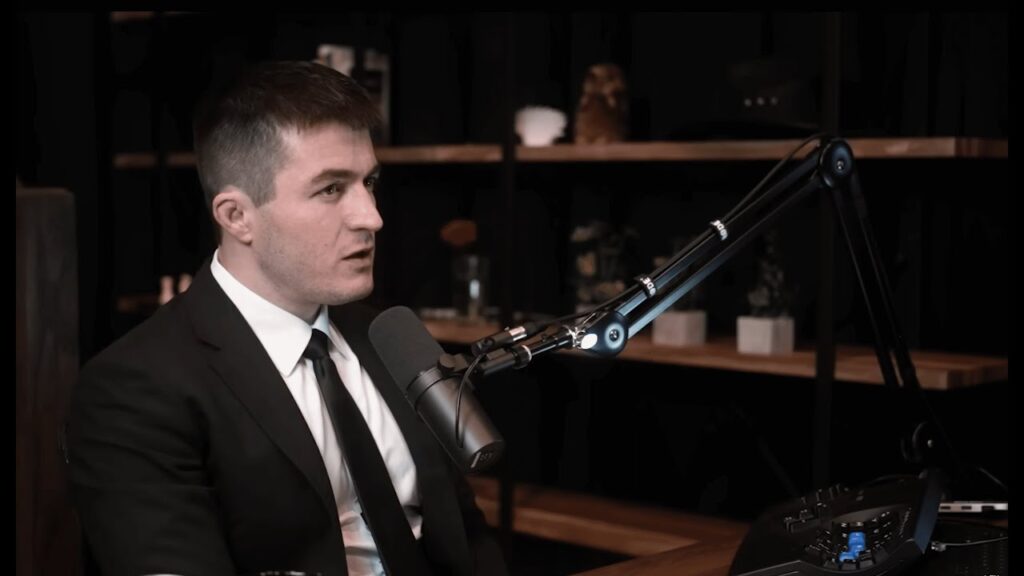

Lex Fridman was born Alexei Fridman on August 15, 1983, in Chkalovsk, then part of the Tajik Soviet Socialist Republic. He grew up in Moscow within a Jewish family with deep roots stretching into Ukraine. Naturally, his environment played a major role in his early development; his father, Alexander Fridman, worked as a plasma physicist, and that scientific household shaped young Lex early on.
Early Life and Roots of Lex Fridman
See also: http://Novaline.com.ng
Democratizing Intelligence: The Inspiring Story of Andrew Ng
Family Heritage and Resilience
Family stories carried significant weight, too. For instance, his grandmother survived the Holodomor and later taught him about resilience and unconditional love. Additionally, his grandfather fought the Nazis as a machine gunner in the Soviet Army. Consequently, Fridman grew up surrounded by both hard science and hard-won family history.
Moving to the United States
In 1994, at age eleven, everything changed dramatically. Shortly after the Soviet Union collapsed, his family immigrated to the Chicago area. As a result, Fridman had to learn a new language, adapt to a new culture, and navigate a foreign school system almost overnight.
High School Years
He subsequently attended Neuqua Valley High School in Naperville, Illinois. Even then, computers and mathematics pulled at his attention far more than most subjects. Ultimately, that early pull toward technology would go on to define his entire professional career.
Academic Journey and MIT Research Career of Lex Fridman
University Studies and Google Experience
Fridman pursued computer science at Drexel University in Philadelphia, where he earned both his Bachelor of Science and Master of Science degrees in 2010. Afterward, he stayed at Drexel to complete a Ph.D. in Electrical and Computer Engineering in 2014.
Furthermore, his dissertation, titled “Learning of Identity from Behavioral Biometrics for Active Authentication,” explored how AI could verify identity through behavior patterns under advisors Moshe Kam and Steven Weber. Before finishing his degree, Fridman also spent time at Google, actively working on early machine learning projects.
Transition to MIT
Meanwhile, his MIT story started modestly. He joined MIT’s AgeLab in an unpaid research role around 2015, studying how humans and machines interact in dynamic environments. From there, his focus expanded naturally into autonomous driving, computer vision, and human-centered AI.
Current Research Focus
Since 2022, Fridman has served as a research scientist at MIT’s Laboratory for Information and Decision Systems. In fact, his lab work laid the technical foundation for everything he would later discuss on his podcast, with semi-autonomous vehicle systems and human behavior modeling becoming his core specialties.
The Rise of the Lex Fridman Podcast
Evolution of the Show
Fridman initially launched his show in 2018 under the name The Artificial Intelligence Podcast. At first, it focused narrowly on AI research and machine learning topics. However, the format quickly evolved into something much broader.
By 2020, he officially rebranded it as The Lex Fridman Podcast. Since then, the show has expanded into physics, philosophy, history, politics, and even competitive sports. Over time, guests have included high-profile figures like Elon Musk, Joe Rogan, Noam Chomsky, and Donald Trump, alongside brilliant scientists, historians, and musicians most listeners had never heard of before.
Audience Reach and Format
Expectedly, the numbers reflect that massive growth. His YouTube channel has attracted nearly five million subscribers and hundreds of millions of views. Meanwhile, episodes routinely run three to four hours—a long-form format many assumed would never work on modern digital platforms.
Recent Directions
Moreover, recent episodes show just how wide his curiosity stretches. In early 2026, Fridman explored the state of AI with researchers Nathan Lambert and Sebastian Raschka, covering everything from open-source models to AGI timelines. Likewise, other recent episodes have tackled Viking history, mathematical infinity, and the technical guts of open-source video software.
The Unfiltered Interview Style of Lex Fridman
Fridman’s interviewing style stands apart from typical media formats. He rarely interrupts guests, and he leans into long silences rather than rushing to fill them. Consequently, guests often open up in ways shorter interviews never allow.
His approach draws heavily on humility rather than confrontation. Instead of scoring points, Fridman asks genuine questions and follows unexpected tangents. For example, a conversation about artificial intelligence might drift into philosophy, love, or personal loss within minutes.
Critics argue this style sometimes lets controversial guests speak without pushback. Supporters counter that unfiltered, long-form conversation reveals more truth than combative interviews ever could. Either way, millions of listeners keep returning for the format.
“I have learned a lot from this podcast over the years. We need more discussion like this in our polarized world.” — a listener review
Legacy and Impact of Lex Fridman on Modern AI Discourse
Fridman occupies a rare space between academic researcher and mainstream media figure. His MIT credentials lend scientific credibility, while his podcast reach rivals many television programs. As a result, he has become one of the most recognizable translators of AI research for general audiences.
He has interviewed leading figures across the AI industry, including executives, engineers, and safety researchers. Through these conversations, complex topics like machine learning, AGI risk, and mechanistic interpretability reach audiences far beyond academic circles. In this way, Fridman functions as a bridge between technical labs and public understanding.
His influence extends past AI into broader intellectual culture, too. Listeners credit the show with introducing them to historians, physicists, and philosophers they never expected to encounter online. Ultimately, Fridman’s patient, curious approach has helped normalize long-form, unhurried conversation in an era built for short attention spans.
Key takeaways From The Biography of Lex Fridman:
- Lex Fridman moved from Soviet-era Tajikistan to Chicago at age eleven, shaping his outsider perspective on American technology and culture.
- His academic path through Drexel and MIT built the technical foundation for his later media career.
- The Lex Fridman Podcast grew from a niche AI show into a wide-ranging cultural platform with millions of viewers.
- His empathetic, unhurried interview style remains both praised and debated across media circles.