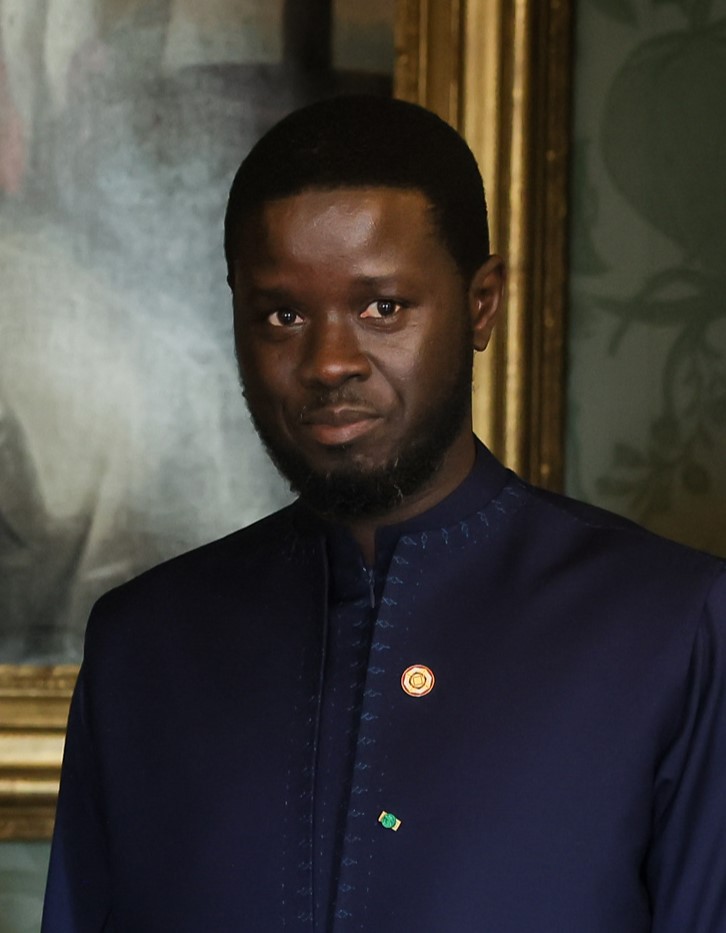

Introduction: The Biography of Bassirou Diomaye Faye
Ten days. That’s how long it took Bassirou Diomaye Faye to go from a prison cell to the presidential palace in Dakar. On March 14, 2024, he walked out of custody after months behind bars. His political activism had triggered the charges. By March 24, voters had handed him the presidency, and he won with over half the vote. So he was sworn in on April 2, 2024. At 44, he became the youngest elected president in Senegal’s history.
No opinion poll saw it coming this fast. Bassirou Diomaye Faye had never held elected office. He had never run a ministry. Until months earlier, he was a mid-level tax official, known mostly within his own agency. Yet his name appeared on ballots anyway. The man voters actually wanted, Ousmane Sonko, had been barred from running. What followed was one of the more compressed political rises in recent African history. This is how it happened, and what Faye has done with the power since.
Early Life & Education of Bassirou Diomaye Faye
See also: http://Novaline.com.ng
Femi Otedola: The Billionaire Who Lost a Fortune on the High Seas — and Built It Back
Faye was born on March 25, 1980, in Ndiaganiao. It’s a farming village roughly 150 kilometers from Dakar. The village had no paved roads and no health center when he was a boy. His family farmed for a living, and friends later described him as a child who tended goats before school. His middle name, Diomaye, comes from the Serer language. It means “the honorable one.” That detail matters, because Senegalese today know him almost entirely by that single name. His father was a longtime member of the Socialist Party. That early exposure to politics shaped him, even though Faye’s own path later cut against the establishment his father supported.
The Path of Bassirou Diomaye Faye Through Senegalese Institutions
He attended Marie Médiatrice Catholic School, then Lycée Demba Diop in Mbour, graduating in 2000. After that, he enrolled at Cheikh Anta Diop University in Dakar. There, he earned a master’s degree in law in 2004. He then trained at the National School of Administration, Senegal’s elite institution for civil servants. That school changed everything. In 2007, after finishing his training, Faye joined the country’s tax and property administration. He became a tax inspector, an unglamorous and technical job. But it put him in daily contact with another young inspector: Ousmane Sonko.
Political Ascent & Partnership With Sonko
Faye and Sonko met at work, not at a rally. Both were civil servants inside the same tax bureaucracy, but both grew frustrated with what they saw happening around them. Sonko founded a union for tax and property agents, and Faye joined it early. That union became the seedbed for something bigger. In 2014, Sonko launched PASTEF, a party built on anti-corruption messaging and economic sovereignty. Faye stayed close to him throughout. He eventually became the party’s secretary general in October 2022. Sonko took the public stage as the movement’s charismatic face. Meanwhile, Faye worked behind it, organizing structure and strategy.
How PASTEF Built Its Base
PASTEF’s appeal ran deepest among young Senegalese voters. They were frustrated with unemployment and a political class they saw as recycled and unaccountable. So the party built grassroots networks across the country, plus support among the diaspora abroad. Faye helped run that expansion as president of the National Movement of Patriotic Cadres, a PASTEF-aligned group. This growth alarmed the government of then-president Macky Sall. As PASTEF’s crowds grew, so did the legal pressure on its leaders. That pressure would soon land directly on Faye.
Imprisonment to the Presidency
In April 2023, authorities arrested Faye. The charges included spreading false information, defamation, and criticizing magistrates connected to Sonko’s case. He spent nearly a year in detention, while Senegal’s political temperature kept rising outside. Sonko, meanwhile, was convicted in a separate case in mid-2023. That ruling effectively barred him from running for president. So PASTEF made a contingency plan. If Sonko couldn’t run, Faye would carry the party’s banner instead. Few outside PASTEF’s inner circle expected that backup plan to matter.
From Prison Cell to Candidate
It mattered enormously. President Sall’s attempt to delay the election sparked unrest and drew heavy criticism. As a result, officials rescheduled the vote for March 2024. Just before the new date, both Faye and Sonko walked free under an amnesty law. Faye had ten days to campaign as a free man. He used them well. Running under the slogan “Diomaye is Sonko,” Faye leaned on his mentor’s popularity. He presented himself as steady and disciplined. Out of nineteen candidates, he won outright in the first round. He took 54.3 percent of the vote, avoiding a runoff entirely. He was inaugurated on April 2, 2024, and quickly named Sonko as his prime minister.
Policy Vision & Global Impact
Faye entered office promising a clean break from business as usual. So he talked about renegotiating mining and energy contracts. He also wanted to audit public finances and reduce Senegal’s reliance on old colonial currency arrangements. Sovereignty, not just growth, became the frame he used again and again. Reality complicated that vision quickly. Faye’s government found that the previous administration had hidden roughly $13 billion in public debt. That pushed Senegal’s real debt level far above what had been reported. The IMF froze a $1.8 billion lending program once the misreporting came to light. Senegal was forced into tough negotiations over subsidies, spending, and fiscal discipline.
The Break Between Bassirou Diomaye Faye and Sonko
Those negotiations became the fault line of Faye’s presidency. Sonko wanted a harder line against the IMF. He framed compromise as a betrayal of the sovereignty they had campaigned on. Faye, running the actual machinery of state, chose the more pragmatic route. In May 2026, he dismissed Sonko as prime minister. He dissolved the entire government in the same move, ending one of Senegal’s most consequential political partnerships. The fallout continued for weeks. So lawmakers elected Sonko as speaker of the National Assembly days later. That gave him a fresh institutional base of his own. Faye, in turn, appointed economist Ahmadou Al Aminou Lo as his new prime minister. This July, he went further and launched an entirely new political party. It formally separated him from PASTEF’s machinery. Senegal now watches two former allies build competing power bases inside the same government.
Conclusion
Bassirou Diomaye Faye’s rise still reads like an anomaly. A little-known tax official became head of state within weeks, but the harder test came after the swearing-in. Campaign promises met hidden debt, IMF negotiators, and a mentor who wanted more radical action than the presidency allowed. Faye chose the pragmatic path over the purist one, and it cost him his closest political ally. What remains is a president governing largely on his own terms. He now has a new party and a rival occupying the National Assembly’s top chair. Senegal’s next chapter will test whether Faye’s cautious reform can outlast the very movement that carried him to power.