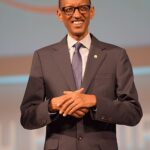

A nation in economic freefall handed him the keys anyway. That was Ghana in December 2024. The man voters chose to fix it was someone they had already fired once. John Dramani Mahama had lost the presidency in 2016. Eight years later, he walked back into the Jubilee House with a landslide behind him. Few African leaders have pulled off that kind of political resurrection. His story does not begin with grand ambition. It begins in the northern town of Damongo, in a household already fluent in the language of power.
The Early Life of John Dramani Mahama Shaped by Politics and Loss
See also: http://Novaline.com.ng
Paul Kagame: The General Who Rebuilt a Nation and Never Loosened His Grip
Mahama was born on November 29, 1958, in Damongo, in what is now Ghana’s Savannah Region. His father, Emmanuel Adama Mahama, served in Parliament and later as a regional commissioner. He worked under Kwame Nkrumah, Ghana’s founding president. Consequently, young Mahama grew up around debate, governance, and the machinery of the state. That proximity to politics came at a personal cost. When Nkrumah’s government fell in 1966, the family’s fortunes shifted overnight. Still, Mahama pursued his education with determination, eventually earning a degree in history from the University of Ghana. He later studied communication at the Moscow Institute of Social Sciences, an experience that broadened his worldview considerably. Before politics, Mahama worked in publishing and communications. He wrote, edited, and eventually built a career explaining Ghana to itself—a skill that would later define his political voice.
The Journey of John Dramani Mahama From Bole’s MP to Vice President
Mahama entered elective politics in 1996, winning the parliamentary seat for Bole in Ghana’s Northern Region. He held that seat continuously until 2009. That run of service earned him a reputation as a steady, unflashy legislator. During this period, he also served as Deputy Minister and then substantive Minister for Communications under President Jerry Rawlings. His profile rose sharply after the 2008 election. Running as the National Democratic Congress’s vice-presidential candidate alongside John Atta Mills, Mahama helped secure a narrow but decisive victory. As a result, he became Ghana’s fifth vice president in January 2009. Then tragedy intervened. President Atta Mills died suddenly in office in July 2012. Constitutional succession placed Mahama in the presidency with almost no transition period. He had to govern immediately, without the usual runway new leaders expect.
A First Presidency Marked by Energy Crises
Mahama won a full term later in 2012, defeating Nana Akufo-Addo in a closely contested race. His first term, however, became defined by “dumsor,” the rolling power outages that frustrated businesses and households alike. Energy shortages dominated headlines and, ultimately, public patience wore thin. To his credit, Mahama also expanded infrastructure aggressively during these years. Roads, hospitals, and schools multiplied across the country, particularly in underserved regions. Meanwhile, he chaired the Economic Community of West African States from 2013 to 2015, raising Ghana’s regional profile. None of that infrastructure spending, though, could offset voter frustration over the economy and electricity. In December 2016, Akufo-Addo defeated Mahama decisively. It marked the first time an incumbent Ghanaian president lost a re-election bid outright.
Years in Opposition and a Persistent Comeback Bid
Losing power rarely ends a political career gracefully, yet Mahama refused to fade. He ran again in 2020, narrowly losing to Akufo-Addo in a contested result. Rather than retreat, he stayed visible, rebuilding trust within the NDC and beyond it. By 2024, Ghana’s economic situation had deteriorated sharply. Inflation soared past 23 percent, the cedi collapsed against major currencies, and the country underwent a painful debt restructuring. Voters, weary of austerity, began looking backward for reassurance. Mahama campaigned on competence and familiarity rather than novelty. He selected Professor Naana Jane Opoku-Agyemang as his running mate again, continuing a partnership first forged in 2020. In December 2024, the ticket won a landslide victory, and Ghana made history in the process.
The Historic Second Presidency of John Dramani Mahama
On January 7, 2025, John Dramani Mahama took the oath of office for a second, non-consecutive term. No previous Ghanaian president had ever been voted back into power after an election defeat. Additionally, Opoku-Agyemang became the country’s first female vice president, another milestone for the Fourth Republic. His early priorities centered on economic stabilization. According to his administration, inflation fell from over 23 percent in late 2024. It reached roughly 3.4 percent by April 2026. Meanwhile, the cedi appreciated significantly against the US dollar over the same period. Beyond economics, Mahama launched the Free Primary Healthcare Programme, aiming to remove financial barriers to basic medical care. He also pushed the “Big Push” infrastructure initiative, targeting roads, rail lines, and grid capacity nationwide. Therefore, his second term reads less like reinvention and more like refinement of old priorities under sharper pressure.
Diplomacy, the African Union, and Global Positioning
Mahama’s international ambitions extended past Accra almost immediately. In February 2025, he became Second Vice Chairperson of the African Union, working alongside Chairperson João Lourenço. This role gave him a louder platform on continental issues, including debt reform and reparations advocacy. At the United Nations General Assembly, Mahama introduced the Accra Reset Initiative. The proposal calls for reforming global governance structures that, in his view, disadvantage Africa and the wider Global South. Consequently, Ghana’s foreign policy under his second term leans more assertively outward than during his first. His advocacy work has not gone unnoticed academically either. In March 2026, Lincoln University in Pennsylvania announced plans to award him an honorary doctorate. The citation specifically noted his record on justice and reparations advocacy. Although the visit was later postponed, the honor itself signaled his growing international standing.
Family Life and Personal Values
Away from Parliament and summits, Mahama’s personal life centers on family. He has been married to Lordina Mahama since 1992, and together they have four children. Their son Sharaf has occasionally drawn public attention of his own. Mahama identifies as a practicing Christian and often references his faith in public addresses. He frequently appears at church events, including visits with ministry groups to hospitals and community outreach programs. These appearances, while modest in scale, reveal a leader who still values direct public contact.
Why The Story of John Dramani Mahama Still Matters
Mahama’s career defies the usual arc of African political biographies. He lost power, rebuilt his standing patiently, and won it back through the ballot box rather than force. In doing so, he gave Ghana’s democracy a rare demonstration of peaceful, repeatable accountability. Whether his second term ultimately matches the promise of 2025’s turnaround remains an open question. Economic indicators look stronger, yet delivery on healthcare, jobs, and infrastructure will define his lasting legacy. For now, though, his comeback alone has already reshaped what Ghanaians believe is politically possible.