
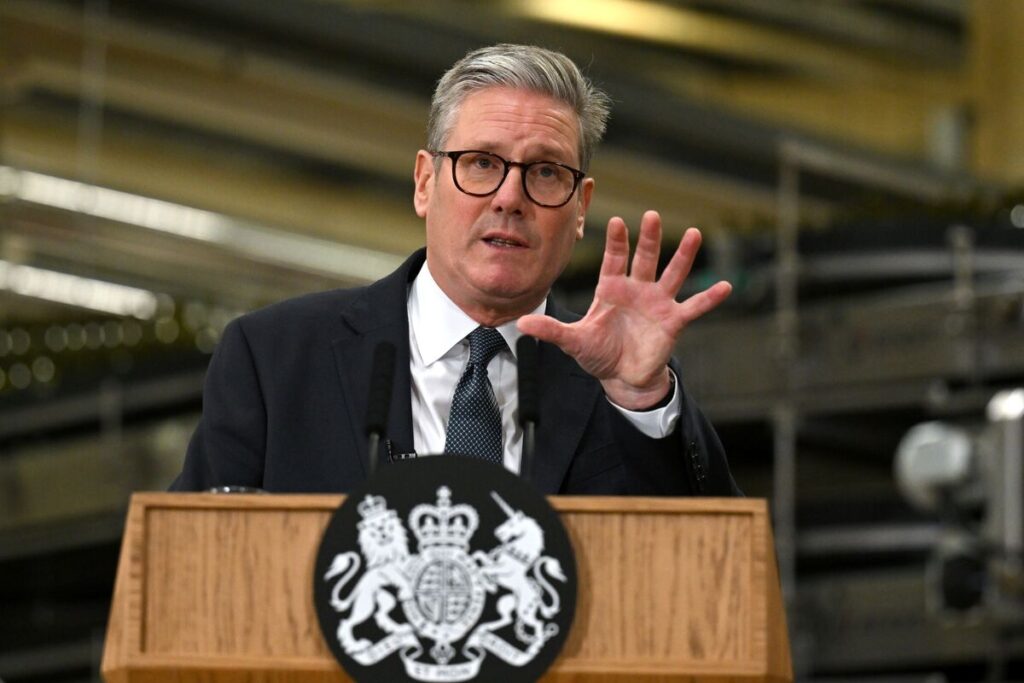

How a shy boy from Surrey became a top lawyer. Keir Starmer was named after a Labour pioneer. He prosecuted the powerful. Ultimately, he became the Prime Minister who fell to his own party.
The Oxted Roots & The Name – Keir Starmer
See also: http://Novaline.com.ng
Narendra Modi Biography: The Chai-Seller Who Became India’s Longest-Serving Modern Prime Minister
There is a particular kind of quiet in a home where money is counted before it is spent. Keir Starmer grew up inside that quiet. He lived in a pebble-dashed semi in Oxted, an unremarkable Surrey commuter town.
Inside, the household ran on a rigid code. Work hard, do not complain, and never forget your roots. The family scraped together enough funds to send four children through school on a toolmaker’s wage.
Family Ties and Formative Lessons
His father, Rodney, made precision tools in a factory. He was not an emotionally easy man to reach. Praise was rationed, and affection was merely implied.
His mother, Josephine, worked as an NHS nurse. However, her decades-long battle with Still’s disease shaped her son’s political conscience. This brutal, inflammatory arthritis cost her a leg. It nearly took her life more than once.
Starmer watched his mother endure countless operations. He saw NHS staff not as a bureaucracy, but as dedicated people. They showed up for a family with nothing to offer but gratitude.
That lesson never left him. Institutions are only as good as the individuals inside them. Safety nets are the literal difference between dignity and despair.
An Inherited Name and a Seismic Path
Then there was the name itself. His parents called him Keir after Keir Hardie. Hardie was the Scottish miner who founded the Labour Party. He walked into Parliament in a tweed cap. He reminded the aristocracy that labour built the nation.
It was not a name chosen lightly. It was a small act of political faith performed in a maternity ward. His parents wagered this child would carry that conviction forward.
Starmer admitted the weight of the name embarrassed him as a boy. He did not appreciate the inheritance until much later. By then, the name had quietly written expectations into his character.
He was the first in his family to go to university. He read law at Leeds before a postgraduate stint at Oxford. In a different family, this trajectory might be unremarkable. In his house, it was seismic.
Social mobility carries its own private cost. It brings a sense of straddling two worlds, fluent in neither completely.
Starmer spent much of his later career facing two accusations. Critics said he either forgot his roots, or never quite escaped them.
Both critiques miss what actually happened in Oxted. A boy learned early that duty is not glamorous. He learned that institutions matter more than ideology. Finally, he saw that the people keeping a country afloat rarely get thanked.
The Radical Lawyer & Defender – Keir Starmer
Long before entering politics, Keir Starmer was a busy barrister. He had a reputation for taking cases that paid badly and risked much.
In the 1990s, he worked with lawyers defending death-row prisoners across the Caribbean. He argued against mandatory death sentences in Jamaica, Trinidad, and Belize. He took these cases to the Privy Council in London.
It was unglamorous, painstaking human rights law. The work rarely made headlines, but it occasionally saved a life.
He also represented environmental campaigners in the famous McLibel case against McDonald’s. This marathon legal battle became a symbol of ordinary people standing up to corporate power.
This was Starmer the activist-lawyer. He was instinctively suspicious of unchecked authority and drawn to the underdog. He felt comfortable with people the establishment preferred to ignore.
Becoming the State’s Chief Enforcer
Starmer has never fully dodged a striking irony. This same radical man would later become the literal embodiment of state authority.
In 2008, he was appointed Director of Public Prosecutions. He became head of the Crown Prosecution Service for England and Wales. He was the person who decided who gets charged with a crime.
It is difficult to overstate the psychological pivot this role required. The man who once argued the state overreached was now its chief legal enforcer.
He was responsible for prosecuting phone-hacking journalists. He handled MPs caught in the expenses scandal and sensitive terrorism cases.
Colleagues from that era describe a man who compartmentalised fiercely. He held activist convictions in one hand and prosecutorial neutrality in the other. He refused to let either contaminate his judgment.
Meticulous Caution and a Knighthood
As Director of Public Prosecutions, Starmer earned a reputation for meticulous caution. Critics later mocked this trait as robotic. Inside the CPS, professionals regarded it as exactly what the job demanded.
He introduced new guidance on assisted suicide prosecutions. This was a rare instance of a state lawyer bringing humanity to a grieving area of law.
He was knighted for his service in 2014. He became Sir Keir Starmer before he had won a single vote from the public.
It is worth sitting with that fact. He was “Sir Keir” before becoming the MP for Holborn and St Pancras.
His instinct for institutional service came first. His appetite for elected politics came later, forced by circumstance rather than raw ambition.
The Political Ascent & The 2024 Triumph
Starmer entered Parliament comparatively late. Specifically, he won election as a Labour MP in 2015 at age 52. By that age, most senior politicians have spent a decade climbing the greasy pole.
Furthermore, he arrived into a party in deep turmoil. Jeremy Corbyn’s leadership was actively reshaping Labour around a hard-left platform. This thrilled activists but alarmed the broader electorate in equal measure.
Consequently, Starmer served in Corbyn’s shadow cabinet as Shadow Brexit Secretary. In this role, he navigated one of the most thankless briefs in modern British politics.
Indeed, the party split between Leave-voting heartlands and Remain-voting cities. Therefore, colleagues expected Starmer to hold both factions together. He used nothing but careful legal drafting and diplomatic exhaustion.
Rebuilding the Labour Party
Subsequently, he won the Labour leadership in 2020 following Corbyn’s catastrophic election defeat. Starmer inherited a party that the country had emphatically rejected.
As a result, what followed was less a political campaign than a complete demolition and rebuild. He conducted this project with the same procedural patience he brought to prosecutorial files.
First, he tightened party discipline immediately. Next, he distanced Labour from its most electorally toxic associations.
Thus, he pursued a project known as “changed Labour.” This was less about ideological reinvention. Rather, it was about proving the party could be trusted with the machinery of government.
The Methodical Drive to Victory
However, critics found their line early and never let go. They argued Starmer was wooden and cautious to the point of evasiveness. Critics said he answered questions like a lawyer parsing a deposition.
Admittedly, it was not entirely unfair. He rarely offered the rhetorical flourish that defines natural political charisma.
But beneath the flat delivery sat a stubborn internal drive. This drive carried a toolmaker’s son through Leeds, Oxford, and the DPP’s office.
In short, he did not need public love. He needed to win methodically, the way a tough legal case is won. He built his victory brick by brick.
Ultimately, it worked. In July 2024, Labour swept back into power with a historic majority. They ended fourteen years of Conservative government battered by austerity and Brexit turmoil.
Finally, Starmer stood outside 10 Downing Street as the new Prime Minister. It was the culmination of a long journey.
That journey began in a modest Surrey semi. His parents named him after a man who fought for people exactly like the Starmers.
The Crucible of Power & Legacy
Governing turned out to be a completely different discipline from winning. Previously, caution had served Starmer well in opposition. However, in office, that careful hedging curdled into something that felt like drift.
Indeed, his government inherited a brutal set of circumstances. For instance, they faced strained public finances and a fractured NHS. Furthermore, they dealt with an electorate exhausted by broken promises of stability.
Consequently, difficult and unpopular reforms followed. Unfortunately, these actions rarely win public affection, even when they are administratively necessary.
In fact, the discipline that made him an effective prosecutor changed his reputation. As a result, many in his party saw a manager of problems rather than an inspiring leader.
The 2026 Leadership Crisis
By the spring of 2026, the pressure became structural rather than incidental. Specifically, Labour suffered a disastrous showing in the May local elections while Reform UK surged.
Subsequently, this electoral failure triggered a slow-motion crisis inside the parliamentary party. Soon after, major cabinet resignations followed.
Most consequentially, Defence Secretary John Healey resigned in June. Undeniably, this high-profile defection stripped away much of Starmer’s remaining authority.
Then, Andy Burnham engineered a return to Parliament via a by-election victory in Makerfield. Consequently, the popular Greater Manchester mayor cleared the path for a formal leadership challenge. Therefore, much of the cabinet, including Wes Streeting, moved to back Burnham.
The Exit and the Country Before Party Ethos
On 22 June 2026, Starmer stood once more outside Downing Street. Consequently, he announced his resignation as Labour leader and Prime Minister. Ultimately, he accepted the answer his parliamentary party gave him.
Because he spent a career respecting due process, he did not simply walk away. Therefore, he set out a clear timetable for the political succession.
He pledged to remain in post through an orderly transition. In addition, he promised full support to whoever followed him. Reports indicated Burnham held the overwhelming lead after Streeting stood aside.
Indeed, this brings a strange ending for a man who prized institutional stability. However, the accumulated exhaustion of his party broke a Prime Minister. Ultimately, colleagues stopped believing he could win.
Of course, history will judge Keir Starmer in hindsight. Did he restore competence as a steady hand, or did his caution curdle into paralysis?
What remains indisputable is his lifelong throughline. For example, a Surrey childhood instilled the unglamorous virtues of duty in him.
He defended the powerless as a barrister before prosecuting for the state. Finally, he chose an orderly handover over a bitter fight.
Thus, “Country before party” never served as a mere slogan for Starmer. It was the only instinct he had left to follow.
Editorial note: As of early July 2026, the Labour leadership contest remains ongoing. Specifically, nominations opened July 9 and close by the summer recess. The party expects a new leader before Parliament returns in September. Meanwhile, Starmer remains in post as caretaker Prime Minister until that process concludes.