

The Waiting in the Forest – Jane Goodall
See also: http://Novaline.com.ng
The Toolmaker’s Son: A Keir Starmer Biography of Duty, Distance, and Downing Street
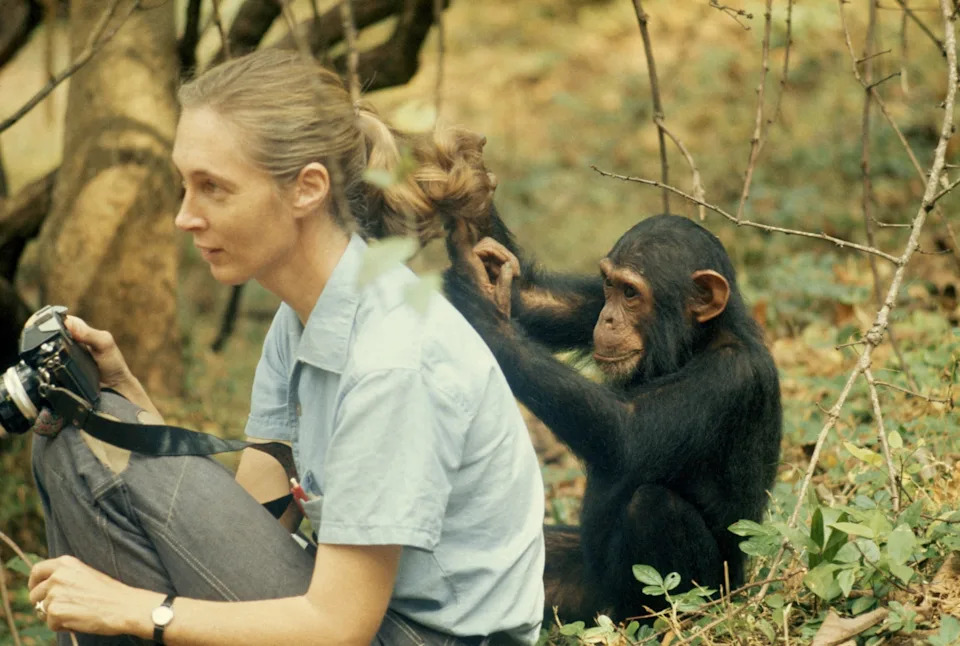
To begin with, the forest floor at Gombe Stream National Park does not announce its visitors. At dawn in July 1960, a 26-year-old English woman sat motionless on a ridge. Indeed, with binoculars pressed to her face, she watched a canopy that refused to watch her back.
In fact, she had already been there for weeks. Furthermore, the chimpanzees fled at the mere suggestion of her scent. Meanwhile, her mother lay sick with malaria in a tent below.
Therefore, she simply sat. Ultimately, being patient, unhurried, and willing to be ignored was her only method. As it turned out, it was also the only method that worked. For this reason, every Jane Goodall biography must begin here. Specifically, we must look at the waiting that made the discovery possible.
What she found in that valley did far more than just fill a gap in zoology. In particular, it moved the fence line separating humans from the rest of the animal kingdom. In fact, it moved it so far that scientists spent years arguing the fence should be torn down. Jane Goodall’s chimpanzee research did not just describe a species. Instead, it asked humans to reconsider what made them special.
The Stuffed Chimpanzee and a Dream
Margaret and Mortimer Morris-Goodall welcomed their daughter, Valerie Jane, into the world on April 3, 1934, in Hampstead, London. When she was still a toddler, her father gave her a stuffed toy chimpanzee named Jubilee. Notably, this gift commemorated the birth of a real chimp at the London Zoo.
Naturally, family friends worried the toy would give the child nightmares. However, she carried it everywhere anyway. Decades later, it still sat on her dresser as a small, worn artifact of a lifelong fixation.
Childhood of Jane Goodall Was Shaped by Ambition
She grew up mostly in Bournemouth, on England’s south coast. Instead of a traditional upbringing, her mother, grandmother, and aunts raised her after her parents divorced. Unfortunately, there was no money for university. Consequently, her free time was spent reading Doctor Dolittle and Tarzan of the Apes obsessively.
Later, she admitted that she found the fictional Jane a disappointment, feeling certain she would have made a better companion for Tarzan. Driven by this passion, she left school at eighteen and trained as a secretary. Afterward, working as a waitress allowed her to save enough money for a ship’s passage to Kenya.
Jane Goodall- an Uncluttered Mind Meets Louis Leakey
Fortunately, her lack of scientific credentials acted as an instrument, not a disadvantage. She arrived in Africa in 1957 without theoretical academic frameworks. Consequently, she had no habit of assigning numbers instead of names, nor did she feel institutional pressure to describe behavior in detached laboratory vocabulary. Rather, the young researcher simply watched and wrote down what she saw.
Discovery at Olduvai Gorge
The crucial hinge point came through a chance introduction to paleoanthropologist Louis Leakey. At the time, he was the curator of the Coryndon Museum in Nairobi. Soon after, Leakey hired her as a secretary and brought her along on fossil digs at Olduvai Gorge.
In a short time, he noticed something in her patience that mattered more than a diploma. The scientist wanted someone to conduct a long-term study of wild chimpanzees, believing their behavior might illuminate how early hominids lived. Therefore, he sought a mind uncluttered by academic bias. In short, Jane Goodall was exactly what he was after.
Jane Goodall Redefining Humanity at Gombe
However, the first months at Gombe Stream National Park nearly broke the project before it began. Both Goodall and her mother contracted malaria. Meanwhile, the chimpanzees bolted at the sight of her from hundreds of yards away. As a result, weeks passed with barely an observation worth recording, and her modest funding began to run out.
The Breakthrough with David Greybeard
Fortunately, a breakthrough arrived with a name: David Greybeard. He was the first chimpanzee to tolerate her presence at a shrinking distance. Eventually, the primate moved through camp with total indifference to her being there. Because of his trust, the rest of the community began to accept her as well. Subsequently, Goodall later called him her favorite chimpanzee of all time.
Most importantly, David Greybeard gave her the discovery that rewired a discipline. For example, she watched him strip leaves from a twig, poke it into a termite mound, and withdraw it coated in insects. Crucially, chimpanzee tool use had never been documented before.
At the time, scientific consensus held that toolmaking separated humans from animals. Therefore, Goodall quickly cabled Leakey with what she saw. His famous reply changed anthropology forever:
Now we must redefine tool, redefine Man, or accept chimpanzees as human. — Louis Leakey, 1960
Defying the Scientific Establishment
However, the scientific establishment did not receive her gently. For instance, Goodall named her subjects—Flo, David Greybeard, Frodo, and Fifi—instead of assigning them numbers. Critics accused her of anthropomorphizing her subjects, claiming she wrote like a diarist rather than a researcher.
Nevertheless, she kept naming them anyway. After all, numbers could not capture the individual personalities, family loyalties, and grief she witnessed. Ultimately, history sided with her.
Indeed, the behavioral complexity she documented forced primatology to accept animal individuality as real data. In the end, she did not lower science to meet her subjects. Rather, she raised the standard for seeing them clearly.
From Researcher to Crusader – Jane Goodall
For more than two decades, Goodall’s life orbited Gombe. She earned a PhD in ethology from Cambridge in 1965 without an undergraduate degree. Her early work, expanded into In the Shadow of Man, made her globally famous. However, the arc of her career bent sharply in 1986.
The Turning Point in Chicago
That year, she attended a conference in Chicago for chimpanzee researchers. What she heard there dismantled the comfortable boundaries of her research life. Habitat destruction was accelerating across Africa. Furthermore, poaching was gutting chimpanzee populations outside protected borders.
Laboratories were also using chimps in invasive medical experiments. She arrived at that conference a field scientist. Consequently, she left it as a full-time activist.
In 1977, she founded the Jane Goodall Institute to formalize the ongoing research at Gombe.
After 1986, the Institute’s mission widened dramatically into community-centered conservation. In 1991, she founded Roots & Shoots with twelve high school students in Dar es Salaam. Today, this global youth network operates in dozens of countries. The premise remains beautifully simple: young people do not need permission to start fixing the world.
The Legacy of Hope
For the last four decades of her life, Goodall rarely stayed anywhere long. She traveled for roughly 300 days a year well into her eighties. She moved constantly between lecture halls and government offices.
Throughout her travels, she carried the same vital message. She insisted that hope was a discipline practiced through action.
|
Milestone / Honor |
Year |
Significance |
|---|---|---|
|
Gombe Fieldwork Begins |
1960 |
Discovered chimpanzee tool use. |
|
Cambridge PhD |
1965 |
Earned doctorate without a prior bachelor’s degree. |
|
Jane Goodall Institute |
1977 |
Created a global leader in community conservation. |
|
UN Messenger of Peace |
2002 |
Recognized for global advocacy work. |
|
Presidential Medal of Freedom |
2025 |
Awarded America’s highest civilian honor. |
Jane Goodall died peacefully on October 1, 2025, at the age of 91, in Los Angeles, California. She passed away in her sleep while in the middle of a speaking tour.
Therefore, there was no retirement chapter or long withdrawal from public life. She simply kept moving until she stopped. What she leaves behind is a completely recalibrated sense of where the line sits between us and nature. She made it impossible to look at animals, or ourselves, the same way again.
Quick Facts About Jane Goodall
- Born: April 3, 1934 — Hampstead, London, England
- Died: October 1, 2025 — Los Angeles, California (Age 91)
- Key Discovery: Chimpanzee tool use and modification (Gombe, 1960)
- Education: PhD in Ethology, Cambridge University (1965)
- Organizations Founded: Jane Goodall Institute (1977), Roots & Shoots (1991)
- Major Honors: DBE (2003), UN Messenger of Peace (2002), Presidential Medal of Freedom (2025)
Frequently Asked Questions About Jane Goodall
When did Jane Goodall live and die?
She was born on April 3, 1934, in London, England. She died at age 91 on October 1, 2025, in Los Angeles, California, during a national speaking tour.
What was Jane Goodall’s most important scientific discovery?
In 1960, she observed a chimpanzee named David Greybeard stripping leaves off a branch to fish for termites. This observation proved that humans were not the only species to make and use tools.
Did Jane Goodall go to college before working at Gombe?
No, she did not have a college degree when she began her research. However, Louis Leakey later helped her enter Cambridge University, where she earned a PhD in ethology in 1965.
What is the purpose of the Jane Goodall Institute?
Founded in 1977, the Institute protects the chimpanzees of Gombe. Additionally, it leads global community-centered conservation and runs the Roots & Shoots youth program.