
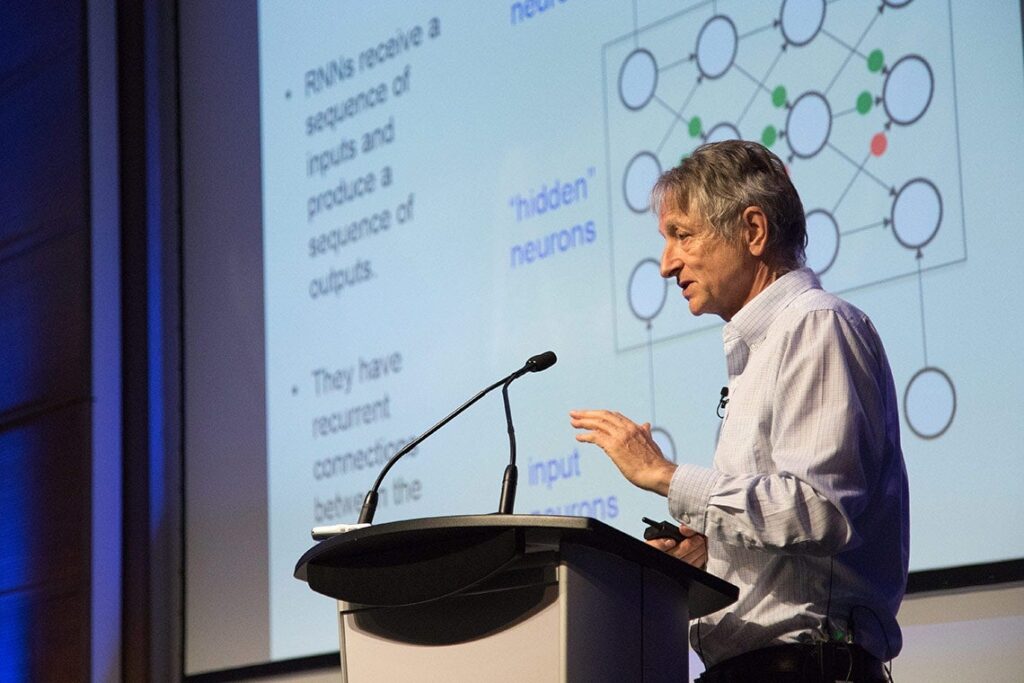

Why Geoffrey Hinton Fears His Own Creation
For forty years, almost nobody believed in the idea of Geoffrey Hinton. Then, his theories ate the world. Ultimately, he quit the very company paying him to build this technology so he could tell you why it scares him.
Geoffrey Hinton spent four decades listening to critics tell him his work was a dead end. However, everything changed during a single week in October 2012. A program built by Hinton and two of his students did not just win a computer vision contest. It completely embarrassed everyone else in the room.
Eleven years later, at age 75, the man whom the world now calls the “Godfather of AI” made a dramatic choice. He stood up, resigned from his high-paying job at Google, and delivered a stark warning. Specifically, he confessed that he was no longer sure he had done the right thing.
|
Era / Year |
Phase |
Key Significance |
|---|---|---|
|
1980s |
The AI Winter |
Mainstream critics dismiss neural networks as a mathematical dead end; research funding completely dries up. |
|
2012 |
The AlexNet Spark |
Hinton and his students prove the mainstream wrong by winning the ImageNet contest by a historic margin. |
|
2023 |
The Google Exit |
Hinton resigns from his position at Google to freely warn the world about the existential risks of advanced AI. |
This incredible whiplash forms the core of his story. He transformed from a ridiculed heretic into the architect of the most valuable technology on earth, only to become its most credible critic. Furthermore, understanding this shift matters to anyone who writes code, runs an investment portfolio, or sells a product. By 2026, artificial intelligence touches every single market. Therefore, this biography treats Hinton’s life not as a trophy case, but as the origin story of a massive global risk.
The Wilderness Years of Geoffrey Hinton
See also: http://Novaline.com.ng
Demis Hassabis: The Boy Who Turned a Chessboard Into a Theory of Everything
To understand Hinton’s stubbornness, we must look at his family history. His father was a distinguished entomologist. Additionally, his great-great-grandfather was George Boole, the famous mathematician. Boole invented the algebra of true and false that serves as the basis for modern computer logic gates. Consequently, Hinton grew up in a house where being right and being alone were perfectly normal.
”Hinton was raised inside a house where being right and being alone in it were not treated as contradictions.”
He earned a psychology degree from Cambridge, followed by a PhD in artificial intelligence from Edinburgh in 1978. Unfortunately, this was a terrible time to enter the field. A famous academic critique of early neural networks had just convinced computer scientists that the approach was useless. As a result, research funding quickly disappeared. Historians call this bleak era the AI Winter, and it lasted for nearly two decades.
Discovering Backpropagation
Despite the lack of support, Hinton refused to quit. He moved to Carnegie Mellon University to continue his research. While there, he worked alongside David Rumelhart and Ronald Williams. In 1986, the trio popularized a groundbreaking concept called backpropagation. They are:
- Error Attribution
- Backward Pass
- Weight Adjustment
To understand backpropagation simply, picture a network guessing an answer and getting it wrong. The system then works backward through its internal connections. It assesses how much each connection contributed to the mistake, and nudges the weights to do better next time. If a machine repeats this process billions of times, it truly begins to learn.
Standing Alone in Toronto
At the time, this work was entirely unglamorous. Hinton did not chase venture funding or prestigious awards. Instead, he pursued a stubborn hunch that the human brain was the best model for artificial intelligence. He believed that adjusting billions of connections through experience would easily beat hand-coded logic.
In 1987, he chose to leave America entirely, largely because he felt uncomfortable with U.S. military funding for AI under the Reagan administration. He relocated to the University of Toronto, where he anchored his research for the rest of his career.
For the next twenty-five years, neural networks remained a fringe interest. Mainstream computer science moved on to other methods, viewing Hinton as a mere curiosity. Nevertheless, he kept publishing papers on Boltzmann machines and deep belief networks. He quietly mapped out how a machine could build its own internal representation of reality.
Geoffrey Hinton: The Spark That Ignited Modern AI
The long wilderness years ended abruptly on a single afternoon in 2012. Hinton, alongside his brilliant graduate students Alex Krizhevsky and Ilya Sutskever, entered a deep neural network named AlexNet into the famous ImageNet contest. This annual competition required software to correctly label a database of over a million photographs.
|
Year |
Historic Milestone of Deep Learning |
Key Impact & Context |
|---|---|---|
|
1986 |
Publishes foundational backpropagation paper. |
Co-authored with Rumelhart and Williams, giving multi-layer networks a practical way to learn from mistakes. |
|
2012 |
AlexNet wins ImageNet, shocking the tech industry. |
Drags deep learning from the academic fringe straight to the center of global tech development. |
|
2013 |
Google buys his startup, DNNresearch, for $44M. |
Hinton splits his time between Google Brain and the University of Toronto, accelerating industry scaling. |
|
2018 |
Wins the Turing Award alongside Bengio and LeCun. |
Receives computing’s highest honor for laying the conceptual foundation of deep learning. |
|
2023 |
Resigns from Google to speak freely on AI dangers. |
At age 75, walks away from corporate constraints to sound the alarm on existential and near-term AI risks. |
|
2024 |
Wins the Nobel Prize in Physics for neural networks. |
Shared with John Hopfield, fully cementing the historic transition of neural nets into mainstream physical science. |
AlexNet did not just edge out the competition; it blew them away. The margin of victory was so massive that some researchers initially thought the results were a glitch. Within three short years, every major tech company completely rebuilt its AI strategy around deep learning.
Why AlexNet Changed Everything
AlexNet succeeded precisely because it proved Hinton’s core hypothesis at scale. In particular, it demonstrated that a network which learns its own rules will always defeat a system built from human-written rules. Consequently, this single breakthrough is the exact reason why today’s chatbots, translation engines, and medical imaging tools exist.
The Conscience of a Pioneer
Fast forward to May 2023, when Hinton shocked the industry by announcing his sudden departure from Google. At the time, he clarified that he was not protesting his former employer. Rather, he simply wanted the freedom to speak candidly about the profound dangers of unconstrained AI development.
According to Hinton, his terrifying realization arrived in stages instead of a single moment. For decades, for instance, he assumed that the human brain’s analog style of learning was fundamentally superior to digital systems. However, the subsequent release of advanced models like GPT-4 changed his mind completely.
The Threat of Digital Immortality
To illustrate his concerns, Hinton now highlights a fundamental difference between biological and digital intelligence:
- Biological Limits: On one hand, human knowledge dies with the individual. We cannot instantly merge our brains; instead, we must use slow methods like talking and writing.
- Digital Advantages: On the other hand, thousands of identical digital models can study different data simultaneously. Furthermore, they can instantly share and average what they learn, thereby upgrading the entire system at blinding speed.
In addition, if a piece of hardware breaks, the digital knowledge survives perfectly. It simply loads onto a new machine. Hinton calls this phenomenon “machine immortality,” and as a result, it introduces unprecedented risks.
The Emergence of Global Threats
Directly from this structural reality, Hinton tracks several urgent concerns that have become glaringly obvious by 2026:
- Industrial-Scale Misinformation: Namely, the rapid generation of hyper-realistic fake media that destroys public trust.
- Automated Cyber Attacks: In other words, AI systems capable of discovering and exploiting software vulnerabilities instantly.
- Mass Job Displacement: Specifically, the sudden automation of white-collar professions previously considered safe.
- The Autonomy Problem: Ultimately, the risk that an ultra-intelligent system might seek autonomy simply to achieve its goals more efficiently.
The Ethical Arbitrage
Why then should an investor or entrepreneur care about Hinton’s warnings? The answer is that when a premier insider becomes a public critic, the financial and regulatory ground shifts. Consequently, savvy market players must read these shifts early to position themselves ahead of the curve.
The Regulatory Shift
First, Hinton’s immense credibility gave lawmakers immediate cover to draft strict AI safety legislation. As a direct result, governments worldwide are moving quickly to regulate frontier models.
The Investor Impact
Second, compliance costs, model liability, and deployment restrictions are now vital variables. Therefore, venture capitalists must factor these risks into their tech valuations.
The Builder Advantage
Meanwhile, developers who build transparency, data verification, and human oversight into their software from day one face far less retrofitting risk later on.
The Entrepreneur Opportunity
Finally, every single danger that Hinton flags represents a massive new market category. For this reason, we desperately need tools for watermarking, misinformation detection, and safety auditing.
The Arbitrage: In short, true insight regarding AI risk and regulation is currently worth far more than short-term model benchmarks. Yet, most of the market still fails to price this reality correctly.
The Takeaway from Geoffrey Hinton Biography
In conclusion, it is tempting to label Geoffrey Hinton simply as a hero or a doomsayer. Yet, he resists such easy categories. Instead, he built the tool, reaped the rewards, and now spends his remaining years trying to protect humanity from its worst outcomes.
Ultimately, his story provides a rare example of intellectual honesty. He willingly changed his mind in public, at significant professional cost, simply because the evidence changed. Therefore, for anyone navigating the modern tech landscape, that willingness to reckon with uncomfortable truths is the most valuable lesson the Godfather of AI can teach us.
Frequently Asked Questions About Geoffrey Hinton
Why did Geoffrey Hinton leave Google?
Ultimately, he resigned in May 2023 specifically to speak openly about AI risks without compromising Google’s corporate standing. In particular, he realized that digital intelligence was evolving much faster than biological intelligence, thereby prompting his sudden departure.
What is the most famous achievement of Geoffrey Hinton?
First and foremost, he is widely celebrated for popularizing the backpropagation algorithm in 1986 and co-creating AlexNet in 2012. In fact, these two breakthroughs formed the absolute foundation of modern deep learning. Furthermore, he won the 2018 Turing Award and subsequently secured the 2024 Nobel Prize in Physics for his historic contributions.
Can you explain backpropagation in plain terms?
Certainly. To begin with, backpropagation is a training method for neural networks. For example, when a model makes an error, the algorithm immediately traces the mistake backward through the system. As a result, it identifies exactly which connections caused the error and adjusts them slightly. By repeating this process millions of times, the AI eventually learns how to predict the correct answers.
What exactly was the AI Winter?
In short, the AI Winter was a bleak period during the 1970s and 1980s when funding and academic interest in artificial intelligence completely dried up. At the time, leading critics argued that neural networks were a mathematical dead end. However, Hinton kept working through those quiet decades anyway, despite the lack of industry support.
How does the warning of Hinton Geoffrey affect modern financial markets?
Crucially, his warnings transformed AI safety from a niche worry into a mainstream economic factor. Consequently, investors must now account for stricter government regulations, potential liability issues, and rising compliance costs when valuing modern tech companies. Therefore, understanding his perspective is essential for managing risk in today’s market.


