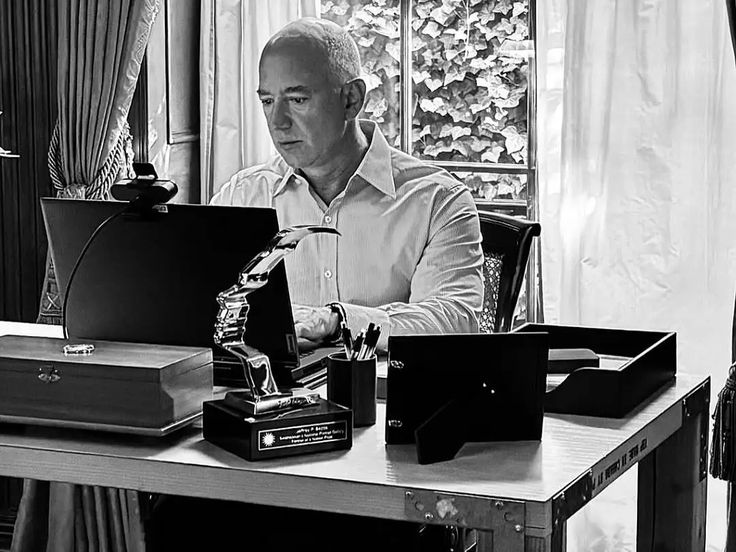

Most billionaire stories are told backward. We naturally know how they end, given that we constantly see the massive wealth, the rockets, and the yachts. Because of this, we tend to go looking for clues at the very beginning, acting as if success was guaranteed all along. However, that is fundamentally the wrong way to look at Jeff Bezos.
Instead, it is much more revealing to look at who he really was back in 1994. At the time, he was simply a 30-year-old hedge fund executive. He had a great salary, a new marriage, and a spreadsheet. To be clear, Bezos was not chasing a massive, world-changing vision just yet. Instead, he had merely found an asset that was priced too low. That asset, as it turned out, was the internet.
Ultimately, he wanted to buy in before the rest of the market noticed. Therefore, this story is not just a standard timeline. It is, rather, the true anatomy of a massive bet. More than anything, it shows the precise mental tools that allowed a man to leave safety behind to build history.
Formative Years: Lessons from a Texas Ranch
Jeff Bezos was born in New Mexico in 1964. His mother was just 17, and his father left early. Later, his mother married Miguel “Mike” Bezos, a Cuban immigrant. Mike adopted Jeff and gave him his last name. But the person who shaped Jeff most did not live in his family home. He lived on a huge cattle ranch in Texas.
Learning Self-Reliance
From age four to sixteen, Jeff Bezos spent every summer on that ranch. He lived with his grandfather, Lawrence Preston Gise. Gise was a former director at the U.S. Atomic Energy Commission who retired early.
On the ranch, they did not call a vet when an animal got sick. They did not hire a contractor when a bulldozer broke down. Gise did everything himself, and his grandson helped.
Bezos said these summers taught him a vital lesson. Hard limits force you to be resourceful. If you have a problem, you must find the solution yourself.
The Value of Kindness
See also: http://Novaline.com.ng
Bezos spent summers fixing windmills, laying water lines, and rebuilding heavy machinery. These chores were not just childhood memories. They became the foundation for how he built Amazon. The ranch taught him to doubt easy answers, accept failure, and value self-reliance over comfort.
His grandfather also taught him a deep human lesson. Once, young Jeff calculated how many minutes of life his grandmother lost by smoking. His grandfather took him aside. He told Jeff that it is harder to be kind than to be clever.
Bezos later used this lesson in a famous speech at Princeton. Cleverness helped him start Amazon, but kindness kept him grounded.
Wall Street: The Hunt for Market Gaps
Jeff Bezos studied engineering and computer science at Princeton. After college, he looked for a fast, highly technical finance job. He joined D.E. Shaw & Co., a unique hedge fund. The firm used computer models to find market mistakes before anyone else. Then, they profited from those gaps.
How Jeff Bezos Spot the Internet Gap
People often forget this part of the Jeff Bezos story. He was not a traditional salesman or retail worker. He was a data expert. His firm focused on arbitrage. This means finding items priced below their true value, buying them quickly, and making a profit.
Bezos excelled here. By his late twenties, he became a senior vice president.
In 1994, Bezos spotted an amazing statistic. He saw that internet usage was growing by 2,300% every year. This was not a small error. He realized that shopping would soon move online. The market did not see this value yet. Bezos did not just view the internet as cool technology. He saw a massive business gap that no one else was closing.
The Pivot: Reducing Future Regret
Leaving his job was a tough choice. Bezos had already won by most standards. He had a great job and a brilliant boss. He also had a new wife, MacKenzie. Quitting meant giving up his large annual bonus.
Bezos told his boss he wanted to sell books online. His boss took him for a long walk in Central Park. He told Bezos that the idea sounded great, but it was better for someone without a good job. His boss made a fair point. Most new businesses fail, and Bezos knew nothing about retail.
The Regret Minimization Tool By Jeff Bezos
To decide, Bezos built a mental tool. He did not ask about his odds of success. Instead, he looked far into the future. He called this the Regret Minimization Framework. It is a simple piece of psychology.
The system works through these steps:
- Look ahead: Picture yourself at age 80. Look past today’s job stress or missed bonuses.
- Accept small failures: Bezos knew that if he tried and failed, he would not regret it at age 80. He would just see it as a great lesson. That kind of regret fades quickly.
- Spot permanent regret: He knew that not trying would haunt him every day for the rest of his life.
- Let the choice become clear: This view changed everything. The risk of trying had a small downside. The risk of doing nothing had a permanent downside.
This tool removed the fear of the unknown. Bezos was not sure Amazon would succeed. But he chose self-respect over temporary comfort.
He quit his job. He and MacKenzie drove to Seattle. Bezos wrote the Amazon business plan in the car. He chose books because they were easy to pack and ship. He started the company in a garage because it was all he could afford.
Growth Strategy: Finding the Edge
Amazon grew quickly because Bezos kept hunting for market advantages. He bought cheap land for warehouses, found low-cost capital, and built cloud networks. He used specific rules to stay ahead of rivals.
The table below breaks down these core ideas.
|
Principle |
What It Actually Means |
The Strategic Advantage |
|---|---|---|
|
“Day 1” Focus |
Amazon must act like a startup forever. This means fast choices and accepting failure. |
Big companies get slow. Staying fast gives Amazon a huge edge over slow rivals. |
|
The Flywheel |
Low prices bring in customers. More customers attract sellers, which increases choice. |
Amazon put profits back into growth. This loop allowed them to beat everyone on price. |
|
Customer Focus |
Amazon starts with what the customer needs and works backward. |
Most stores just copy rivals. Bezos focused entirely on the buyer to win long-term loyalty. |
|
Long-Term Cash |
Amazon kept profits low for years. They put money into tools and tech instead. |
Wall Street focused on quick profits. Bezos built infrastructure that led to AWS. |
Jeff Bezos: The Power of AWS
To begin with, Bezos did not care about pleasing stock analysts every quarter. Instead, he wanted to own the foundational tools of the internet itself.
Consequently, in 2006, Amazon launched AWS to rent out its extra computer servers. This was pure arbitrage in action. Ultimately, they turned an underused, internal asset into a massive, highly profitable business.
Jeff Bezos Unique Rules for Leadership
Beyond his market strategies, Bezos used strict, unique habits to run his teams. In particular, these rules were designed to eliminate bad choices and speed up execution.
- Six-Page Memos: For example, meetings always start in total silence while everyone reads a short essay. This is because Bezos believed bullet points let sloppy thinking hide, while full sentences force it into the open.
- Two-Pizza Teams: Meanwhile, teams must stay small enough to be fed by just two pizzas. As a result, this constraint prevents bureaucratic bloat and keeps groups moving fast.
- Disagree and Commit: Furthermore, employees are expected to voice real disagreements during discussions. However, once a decision is finalized, everyone must commit fully to its success, regardless of their original stance.
- Two-Way Doors: Similarly, Bezos split decisions based on how easy they are to reverse. While fast choices work perfectly for reversible actions, heavy caution is strictly saved for permanent, unalterable decisions.
Admittedly, these rules are not warm or gentle, but they work. By cutting through social noise, they focus the company entirely on real results.
Reaching for the Stars
Looking even further ahead, Bezos quietly started a space company called Blue Origin back in 2000. Its motto translates to “step by step, ferociously.” Far from being just a billionaire’s hobby, this move proved that Bezos was thinking decades into the future.
To support this vision, he bought a massive ranch in Texas for his launch site. Interestingly, the property feels just like his grandfather’s ranch because it is isolated and completely self-sufficient. Eventually, in 2021, Bezos flew into space aboard his own rocket, which finally fulfilled a lifelong childhood dream.
A Lasting Legacy of Jeff Bezos
That same year, Bezos stepped down as Amazon’s CEO to shift his focus toward space travel, climate projects, and media ownership.
Of course, his legacy is not without controversy, as critics still point to ongoing issues like labor practices at Amazon. Without a doubt, these worries are a real, permanent part of his story. Yet, despite the criticism, his long-term focus remains clear. In short, he builds things that take decades to mature.
The Takeaway from the Biography of Jeff Bezos
When you look at the big picture, Bezos’s story offers a clear psychological blueprint. First, his childhood taught him to rely on himself. Next, Wall Street taught him how to find market gaps. Finally, his regret framework gave him the courage to beat fear.
In the end, this blueprint did much more than build an online bookstore. It fundamentally changed how we shop, how companies use computers, and how we make big life choices. By using the fear of regret to guide his path, Bezos handed the rest of us a tool that can help anyone face the biggest decisions in their own lives.