
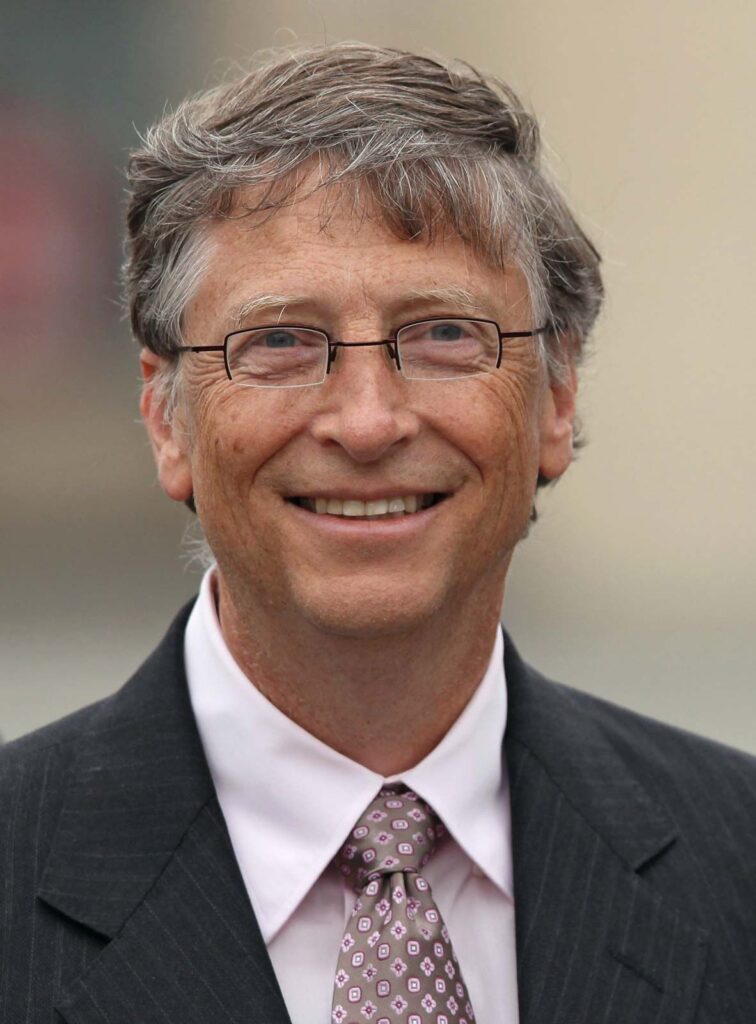

How Bill Gates Built the Tech and Philanthropy Standards Twice
Before the world called him a philanthropist, Bill Gates was something narrower and more dangerous to his competitors: a strategist who understood that whoever controls the licensing terms controls the industry. This is the story of that mind, and what it built twice.
Bill Gates: A Strategist First, a Programmer Second
Strip away the mythology and what’s left is colder and more interesting. Bill Gates did not become the world’s richest man because he wrote the best code. Paul Allen was the better engineer. Gates’ gift sat one layer up, right in the terms of the deal. He focused on the fine print nobody else thought to fight over. His instinct was to ask not “how do I build this” but “who has to pay me every time this gets used.”
That instinct is the throughline of this Bill Gates biography. From childhood, his mind was wired to treat systems, markets, and even human relationships as optimization problems with a scoreboard attached. For example, it shows up in a 1980 contract with IBM. In hindsight, that deal reads like the single most consequential licensing clause of the twentieth century.
Forty years later, Gates pointed the same machinery at malaria, polio, and global aid. Understanding Gates means understanding arbitrage. This is the discipline of buying an asset cheap in one context and extracting its full value in another, at almost no marginal cost. Ultimately, he didn’t build a better product. He built a better toll road and let the whole industry drive on it.
The Lakeside Matrix: Where a Rummage Sale Rewired a Brain
William Henry Gates III was born in Seattle in 1955. He was the middle child of a corporate attorney father and a well-connected mother. In fact, Mary Gates had civic and banking connections that would later matter more to Microsoft’s history than most accounts admit.
During his early teens, his parents worried that their bright, restless son was drifting into isolation. Because of this, their fix was pragmatic rather than sentimental: they enrolled him somewhere harder. At thirteen, Gates entered Lakeside School, a private academy that pushed him in math, science, drama, and English alike.
A Rare Technological Advantage
See also: http://Novaline.com.ng
Jeff Bezos Biography: How a Wall Street Quant Turned a 2,300% Statistic Into an Empire
What happened next was a fluke that behaved like destiny. Lakeside’s Mothers’ Club used proceeds from an annual rummage sale to lease a Teletype terminal. This terminal was wired to a General Electric time-sharing computer. Access was incredibly rare at the time. To put it in perspective, most university graduate programs didn’t have anything comparable.
Consequently, Gates got excused from math class at thirteen years old just to sit at the machine. He quickly wrote a tic-tac-toe program. Later on, the school banned Gates, Paul Allen, and two other students from a separate computer system. The system operators caught them exploiting bugs to steal free processing time. However, the boys talked their way back in by offering to hunt bugs for the company instead.
Discipline Dressed as Curiosity
The Lakeside years reveal the pattern that would define his career: relentless intensity aimed at whatever system sat in front of him. It did not matter whether that system was a scheduling program, a compiler, or eventually an entire industry’s supply chain.
As time went on, a Lakeside teacher recruited Gates and his friend Kent Evans to automate the school’s class-scheduling software. The school paid them in computer time and royalties. Sadly, Evans died in a climbing accident before they finished, so Gates turned to Allen to complete it. Decades later, at a school assembly, Gates put the debt plainly: without Lakeside, there would have been no Microsoft.
Psychology Note: Gates has described the pull of that early terminal as something closer to compulsion than a hobby. He loved the appeal of a machine that executed instructions with total, unambiguous fidelity. For a child who felt friction with the social world, a system that rewarded precision with predictable success was its own kind of relief.
The Ultimate Arbitrage Play
By 1980, Microsoft was a small Seattle software shop with a strong BASIC interpreter and no operating system of its own. Meanwhile, IBM was racing to ship a personal computer under the internal codename Project Chess.
IBM needed an OS fast. Initially, they approached Digital Research, the maker of the dominant CP/M standard, but those negotiations stalled. IBM’s team, led by Jack Sams, turned to Gates instead. Interestingly, reports suggest they mistook the boyish 24-year-old for an office assistant when he first walked into the room.
The Strategic Acquisition
Gates did not have an operating system to offer, so he arranged to acquire one. Microsoft licensed, and later purchased outright, a CP/M-like system called QDOS (“Quick and Dirty Operating System”) from Seattle Computer Products. They paid roughly $50,000 for the rights.
That acquisition alone was unremarkable. However, the structure of the deal Gates then signed with IBM in November 1980 made it historic.
The Clause IBM’s Lawyers Didn’t Fight For
IBM paid Microsoft modest, fixed fees for the operating system, programming languages, and testing. Yet, buried inside the arrangement was the detail that mattered: the license was non-exclusive. IBM would sell PC-DOS on its own machines, but Microsoft retained the right to license the same underlying code, rebranded as MS-DOS, to every other computer manufacturer on the planet.
IBM’s negotiators focused heavily on hardware margins and manufacturing timelines. In their calculus, operating systems were just a commodity input. Gates understood the exact opposite. He saw that the hardware would commoditize fast, and whoever owned the software layer running on top of it would own the industry’s chokepoint.
Therefore, when Compaq and a flood of PC clone makers needed an operating system compatible with IBM’s new standard, only one company was positioned to sell it to them. Microsoft supplied them all at a marginal cost that approached zero, copy after copy.
IBM built the walls, but Microsoft owned the toll on every door. This is software licensing strategy in its purest form. You acquire an asset for a flat, one-time cost, then you rent access to it indefinitely across every customer who needs it. You never have to re-pay that original cost each time.
It is the same logic that governs patent licensing, franchise royalties, and modern SaaS subscriptions. Gates simply arrived at it first, in a room where the other side hadn’t thought to ask for exclusivity.
How Bill Gates Actually Ran Microsoft
The IBM deal explains one transaction, but it doesn’t explain three decades of sustained dominance. That achievement required a management operating system built around three reinforcing pillars.
|
Pillar |
What It Looked Like |
Why It Worked |
|---|---|---|
|
Aggressive Talent Poaching |
Recruiting top computer-science graduates directly out of university, outbidding IBM, and giving young engineers big ownership of product decisions early. |
Microsoft grew its intellectual density faster than competitors could match it, compounding its lead in compilers, languages, and later Windows. |
|
Platform Lock-in |
Bundling MS-DOS, then Windows, then Office, so that switching away from any one Microsoft product meant rebuilding an entire workflow. |
Once a business standardized on Windows-compatible file formats and APIs, the cost of leaving wasn’t the software—it was everything built on top of it. |
|
Paranoia-Driven Management |
Holding grueling product reviews and blunt technical cross-examinations, while assuming a competitor was always 18 months from making Microsoft obsolete. |
The fear of complacency kept release cycles fast. It also kept Microsoft acquiring or crushing threats—like Netscape, Lotus, and Novell—before they scaled. |
Each pillar reinforced the arbitrage logic of the IBM deal: control the standard, make switching costly, and staff the operation with people paranoid enough to defend the toll booth. This is the operational skeleton behind Microsoft’s history. It is not a garage-inventor story, but a systems-control story.
Global Optimization: The Gates Foundation as Second Act
It is tempting to read Gates’ move into philanthropy as a mellowing, as if a ruthless monopolist suddenly traded spreadsheets for sainthood. However, the record suggests something less sentimental. He simply ported the same optimization mindset onto a harder, messier dataset.
Diseases don’t respond to platform lock-in, but they do respond to distribution networks, data systems, and a relentless focus on the marginal cost per life saved. Founded in 2000 with his then-wife Melinda French Gates, the organization has functioned less like a traditional charity and more like a venture fund for public health infrastructure.
The organization was renamed the Gates Foundation in January 2025 after Melinda’s 2024 departure as co-chair. Over the years, it bankrolled the vaccine-delivery apparatus behind Gavi and poured resources into polio surveillance. It also became one of the largest private backers of the Global Fund to Fight AIDS, Tuberculosis and Malaria, a mechanism that helped save an estimated 70 million lives since 2002.
A Deliberate Expiration Date
In a move with no real precedent among foundations of its size, Gates committed to spending down the entire endowment and closing the organization by 2045. The foundation targets the eradication of polio and malaria, alongside a 90 percent cut in TB and AIDS deaths within that window.
This shows the arbitrage instinct turned toward urgency instead of accumulation. Gates believes the value of capital deployed right now against compounding health crises outweighs the value of capital preserved for a future that may never need it as badly.
Of course, that bet has grown harder, not easier. Global development assistance for health fell sharply through 2025. Furthermore, the foundation’s own 2025 Goalkeepers report acknowledged that child mortality is projected to rise for the first time this century after two decades of steady decline.
Gates has responded to this challenge without reassurance. Instead, he uses the same blunt systems language he once used about tech competitors: identify where a dollar saves the most lives, and put it there first.
Gates Foundation Impact, in Numbers: The foundation holds roughly $86 billion in assets as of mid-2025, with a planned spend rate near $10 billion annually. Their stated ambition is to help halve global child deaths again from today’s toll before the foundation’s planned 2045 closure.
Whether this counts as green energy arbitrage, health-system arbitrage, or simply data-driven triage at planetary scale, the mechanism is recognizably the same. It is the exact approach Gates deployed against IBM in 1980: find the point of maximum leverage, control the infrastructure at that point, and let scale do the rest of the work.
The Unyielding Framework of Bill Gates
When you read across seven decades, Gates’ life resists easy labels like “tech genius” or “reformed monopolist.” The same framework connects the teenager exploiting a bug in a mainframe, the twenty-four-year-old who kept the licensing rights IBM forgot to ask for, and the septuagenarian racing to eradicate malaria before a self-imposed 2045 deadline.
He is guided by a mind that never stopped treating the world as a system with exploitable structure. That framework built the operating system that ran the personal-computing era. Now, he aims it with the same impatience at the operating system of global health itself. Few individuals have restructured how our species works and how it survives disease using the exact same underlying instinct. Fewer still have been so unsentimental about doing it twice.
Frequently Asked Questions about Bill Gates
Why is the 1980 IBM deal considered greatest business move of Bill Gates?
Gates licensed MS-DOS to IBM instead of selling it outright. This allowed him to keep the right to license the same code to every other computer maker. IBM built the hardware, but Microsoft owned the toll on every machine that ran it, including IBM’s own competitors.
Did Bill Gates actually write MS-DOS himself?
No, he did not. Microsoft acquired the underlying code, known as QDOS, from Seattle Computer Products. They then adapted and rebranded it as MS-DOS. Gates’ real contribution was the clever licensing structure, not the original source code.
How did Lakeside School shape the career of Bill Gates?
Lakeside’s Mothers’ Club funded a rare Teletype terminal in the late 1960s. This gave a 13-year-old Gates access to computing time that most graduate schools lacked at the time. Gates has stated that Microsoft would not exist without that massive head start.
What is the Gates Foundation’s current impact on global health?
The foundation, renamed from the Bill & Melinda Gates Foundation in 2025, has committed to spending its full endowment down by 2045. It currently targets the total eradication of polio and malaria, alongside a 90 percent reduction in TB and AIDS deaths.