
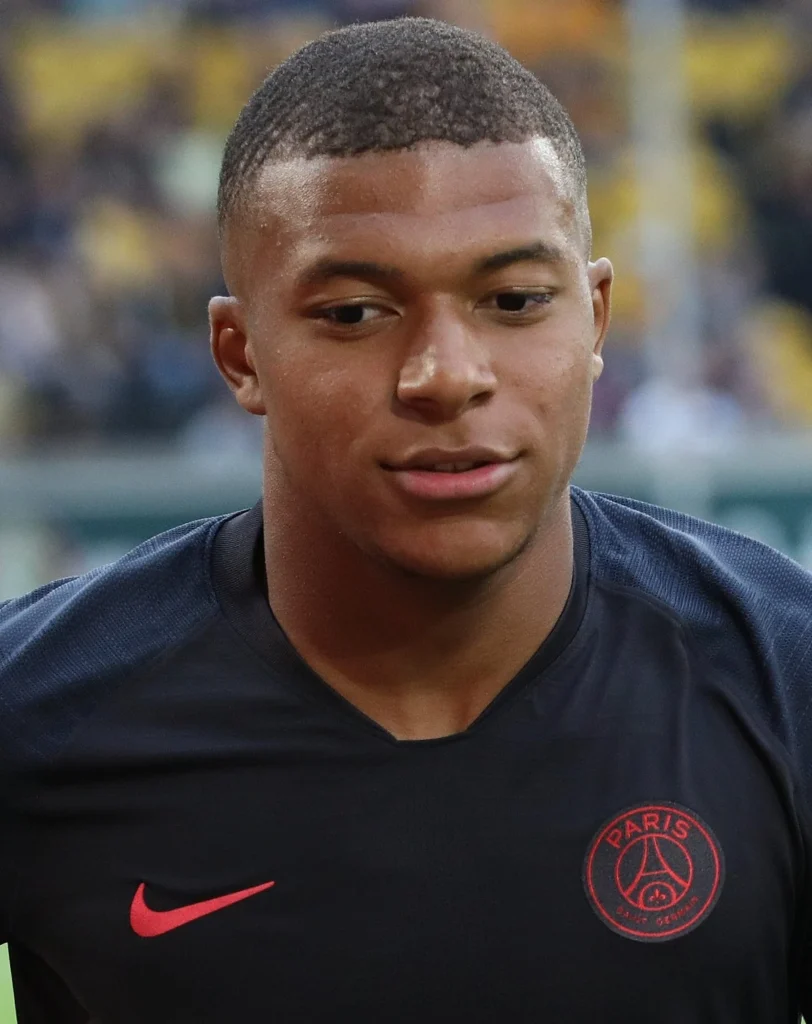

From the concrete pitches of Bondy to the grand stage of Real Madrid’s Santiago Bernabéu, Kylian Mbappé has redefined the archetype of the modern forward. Now leading France as captain into the 2026 World Cup, the 27-year-old stands at the absolute pinnacle of global football—boasting a terrifying 36 km/h peak sprint speed, an astonishing 42-goal haul from the 2025–26 club season, and a historic 19 World Cup goals that place him neck-and-neck with Lionel Messi in the ultimate Golden Boot chase. This is the psychology behind football’s fastest closer.
Kylian Mbappé The Sound of Acceleration
See also: http://Novaline.com.ng
A stadium holds its breath before Kylian Mbappé touches the ball. Then he moves, and the noise changes shape. His first stride swallows five yards of grass. Defenders reset their footing, but the gap already exists. Speed is not his gimmick. Instead, it is his native language.
Scouts have clocked him near 36 kilometers per hour in open sprints. Yet raw pace alone never explained the panic he causes. Because the real threat is the decision behind the sprint. He reads a defensive line the way a pilot reads a runway. So when he lifts off, the whole geometry of a match bends around him.
Meanwhile, commentators still reach for old comparisons that miss the point entirely. This is not borrowed brilliance passed down from a predecessor. His game was built from scratch on Parisian concrete. As a result, by 2026, he stands as football’s most feared closer. He now captains France as the World Cup’s designated main character.
Concrete and Dreams: Bondy
Bondy sits twenty minutes from central Paris, yet it belongs to a different economic universe. Concrete tower blocks frame the skyline. Money is tight, but ambition runs loose in the streets. Kylian grew up here, the son of Wilfried Mbappé, a football coach, and Fayza Lamari, a former handball player.
His parents built a fortress around his talent early. Wilfried coached at AS Bondy, the local club, and watched every training session personally. Fayza, meanwhile, handled contracts and decisions with a lawyer’s precision. Because of that discipline, Kylian avoided the chaotic path that swallows so many gifted kids. Instead, he moved through a structured system designed by people who loved him first and managed him second.
At eleven, Monaco’s academy pulled him away from home. He rose through the ranks quickly, and by December 2015, at just sixteen, he debuted for the senior side. Within two years, he became the club’s all-time youngest scorer and helped deliver a shock Ligue 1 title. So Monaco’s academy became less a stepping stone than a launch pad.
His statistics that season stunned scouts across Europe. But numbers only told half the story. Instead, his composure under pressure signaled something rarer than talent alone. Clubs circled instantly, yet his family kept negotiating on their own terms throughout.
Mbappé made history by making his Monaco senior debut at just 16 years old. He then propelled the club to a stunning Ligue 1 title during the 2016–17 season.
Kylian Mbappé the Prince of Paris
Paris Saint-Germain signed him in 2017 for a fee that shocked the football world. Overnight, a teenager from Bondy became the most expensive prospect in history. Pressure like that crushes most careers before they start. However, Mbappé responded by winning a World Cup within his first year in the capital.
France lifted the trophy in Russia in 2018, and an eighteen-year-old scored in the final. Only Pelé had done that before him at such a young age. So the hometown kid returned to Paris as a global icon rather than a promising rookie. Yet the years that followed carried their own weight.
Captaining PSG meant carrying the emotional temperature of an entire city. Every dropped point became a referendum on his leadership. Rumors about his transfer future turned into national conversations regardless. But Mbappé kept delivering anyway, racking up Ligue 1 titles and scoring records season after season. Because Paris had raised him, leaving felt almost impossible, yet staying meant permanent scrutiny.
Then came 2022 in Qatar, the peak of his PSG-era brilliance. He scored a hat-trick in the World Cup final against Argentina, only to lose on penalties. Still, he claimed the Golden Boot as tournament top scorer. Meanwhile, he had become one of the most photographed athletes alive off the pitch.
Embracing the White Shirt
Leaving Paris meant leaving home, and that distinction mattered more than any transfer fee. In the summer of 2024, Mbappé joined Real Madrid as a free agent. However, arriving at a club stacked with superstars required a different kind of hunger. He was no longer the singular focus of an entire dressing room.
Adjusting took time, and Madrid’s demanding culture offered no grace period. Still, his 2025–26 season proved the move could work on his terms. He finished as La Liga’s top scorer with 25 goals, claiming the Pichichi Trophy for a second straight year. Meanwhile, he also led the Champions League scoring charts with 15 goals. As a result, he scored 42 times in 44 matches across all competitions, a genuinely historic tally.
Mbappé enjoyed a stunning season with Real Madrid, netting 25 La Liga goals. He added another 15 goals in Champions League play. In total, he dominated Europe by scoring 42 goals in just 44 matches.
Yet Madrid rarely offers peace, even to its best performers. Reports of dressing room friction and managerial change surfaced throughout the campaign. Winning remains the only currency that truly matters at the Bernabéu. So questions about trophies followed him regardless of his personal numbers. Still, club president Florentino Pérez repeatedly affirmed his commitment to keeping Mbappé central to the project.
Through all of it, his individual brilliance never wavered. Teammates and coaches continued praising his professionalism behind closed doors. Instead of retreating from criticism, he answered with goals, awards, and public composure.
Kylian Mbappé the Master of the World Stage
Something changes in Mbappé whenever a World Cup begins. Domestic form, injuries, and club noise fall away instantly. Because the tournament rewards nerve above everything else, his temperament becomes the deciding factor. He scored four goals as a teenager in 2018. Four years later, he produced arguably the greatest individual final performance in history.
By the 2026 tournament in North America, he arrived as France’s captain and talisman. He scored freely through the group stage and into the knockout rounds. Then, against Paraguay in Philadelphia, he converted a tense second-half penalty to send France through. That goal pulled him level with Lionel Messi on seven goals for the tournament’s Golden Boot race.
Mbappé has been unstoppable, already netting seven goals during the current 2026 World Cup tournament. This brings his remarkable career total to 19 goals in just 19 tournament appearances. With this clinical form, he sits just one goal behind Lionel Messi’s all-time competition record.
More remarkably, it was his nineteenth World Cup goal in just nineteen career appearances. Only Messi has scored more across World Cup history, with twenty goals total. So Mbappé now sits one strike away from tying the sport’s most decorated active great. Meanwhile, France pushed on toward a quarterfinal against Morocco, chasing a third consecutive final appearance.
Pressure like this breaks most players eventually. Instead, it seems to sharpen Mbappé’s focus further. He treats the World Cup as his proving ground. So every match adds another chapter to a story still unfolding.
Designing the Future of Football
Mbappé represents something larger than goals and trophies now. Young players across Africa and France study his rise as a blueprint. Because his parents managed his career with such intention, his story offers a template for family-guided development. So academies increasingly cite his path as a case study in patient talent management.
Off the pitch, his influence extends into business, fashion, and cultural commentary. He has become a spokesperson for causes ranging from education access to anti-racism initiatives. However, he remains guarded about his private life, preferring to let performances speak first.
Ultimately, his legacy will not rest on comparisons to Messi or Ronaldo. Instead, it will rest on the empire he is actively building, one built on speed, discipline, and relentless reinvention. Because Bondy taught him to fight for every yard, he still plays like someone with something to prove. As a result, the sport’s next decade may well be defined by the athlete who refused to slow down.
Frequently Asked Questions About Kylian mbappé
Where was kylian Mbappé born and raised?
Mbappé was born in Paris in December 1998 and grew up in Bondy, a suburb in the Seine-Saint-Denis department, where his father coached at the local club AS Bondy.
How did the family of Kylian mbappé shape his career?
His father Wilfried managed his early football development while his mother Fayza Lamari, a former handball player, oversaw his contracts and career decisions, creating a tightly guided support system from a young age.
When did Kylian mbappé move from Monaco to Paris Saint-Germain
Kylian Mbappé broke through at AS Monaco as a teenager before joining Paris Saint-Germain in 2017, quickly becoming one of the most expensive young players in football history.
Why did Kylian mbappé leave Paris Saint-Germain for Real Madrid
After years carrying Ligue 1 and PSG’s expectations, Mbappé joined Real Madrid as a free agent in the summer of 2024, seeking a new stage and the chance to compete alongside a roster of global superstars.
How is Kylian mbappé performing at the 2026 world cup?
Mbappé is captaining France at the 2026 World Cup and has scored seven goals through the Round of 16, tying Lionel Messi atop the tournament’s scoring charts as France advanced to the quarterfinals.