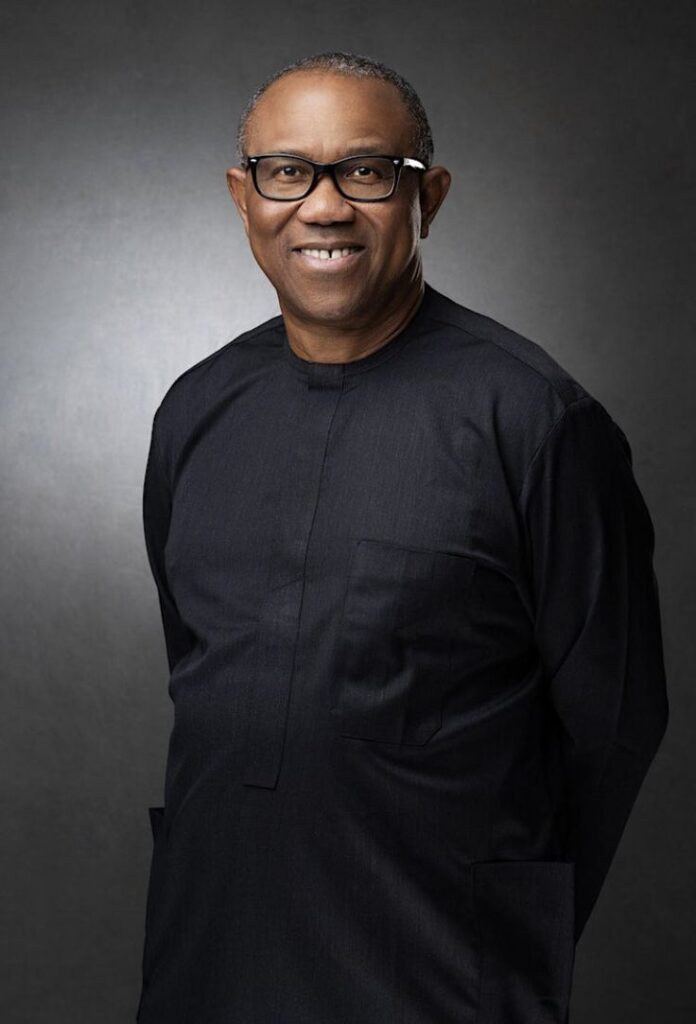

A young banker walked away from a comfortable executive career to chase a governorship he wasn’t supposed to win. That decision, made more than two decades ago, still shapes Nigerian politics today. Peter Gregory Obi turned 65 in July 2026, and he is now campaigning for the presidency for a third time, this time under yet another party banner.
His story does not follow a straight line. It bends through courtrooms, boardrooms, an impeachment, a vice-presidential defeat, and a viral youth movement that changed how Nigerians talk about elections. Understanding Peter Gregory Obi means understanding all of it, not just the highlight reel his supporters share online.
Early Life and the Making of a Banker
See also: http://Novaline.com.ng
The $20 Billion Bet: How Aliko Dangote Rewired Africa’s Economy
Peter Obi was born on 19 July 1961 in Onitsha, Anambra State, into a devout Christian family with roots in Agulu. He attended Christ the King College in Onitsha for his secondary education. Afterward, he studied philosophy at the University of Nigeria, Nsukka, graduating in 1984.
That degree seems an odd starting point for a man who later ran banks and a state economy. However, Obi built his real credentials through business schools. He trained at Lagos Business School, Harvard Business School, Cambridge Judge Business School, and Switzerland’s IMD, among others.
Before politics, Obi worked as a banker and built a career in commerce. This background became central to his political identity. He would later brand himself as the frugal technocrat, a businessman who understood balance sheets better than politicians understood budgets.
Peter Gregory Obi: The Governor Who Got Impeached, Then Reinstated
Obi first contested the Anambra State governorship in 2003 under the All Progressives Grand Alliance. He lost to Chris Ngige, or so it seemed. A court later overturned that result, and in 2006, Obi was declared the rightful winner.
His first term barely survived. On 2 November 2006, the state assembly impeached him, citing gross misconduct, after lawmakers moved against him under heavy police presence at dawn. Obi called the process illegal and unconstitutional, arguing the legislature never met the two-thirds threshold required by law.
Courts eventually agreed with him. Obi was reinstated on 9 February 2007, and the Supreme Court later upheld his position after a lengthy legal battle. He went on to win re-election in 2010, completing a second term that ran until March 2014.
During those years, Peter Gregory Obi cultivated the reputation that still follows him. ThisDay named him the country’s most prudent governor in 2009. The Bill & Melinda Gates Foundation later recognized his state’s immunization performance, a rare instance of a Nigerian governor earning international health-policy praise.
A National Profile Takes Shape
After leaving Anambra, Obi didn’t fade into private life. President Goodluck Jonathan appointed him chairman of the Nigerian Securities and Exchange Commission following the 2015 general election. The role kept him close to national economic policy circles.
In 2018, Atiku Abubakar picked Obi as his running mate for the Peoples Democratic Party’s 2019 presidential bid. The ticket lost to incumbent Muhammadu Buhari, yet the campaign introduced Obi to a much wider Nigerian audience beyond the southeast.
That exposure mattered. Meanwhile, frustration with Nigeria’s dominant two-party system was quietly building among younger voters, and Obi was positioned to benefit from it.
The 2023 Campaign and the Obidient Movement
In March 2022, Obi declared his presidential ambition under the PDP. Weeks later, he pulled out, citing vote-buying and bribery during the party’s primaries, and defected to the little-known Labour Party instead.
What followed surprised almost everyone. Economist Patrick Utomi stepped aside so Obi could claim the Labour Party ticket, and Obi picked Senator Yusuf Datti Baba-Ahmed as his running mate in July 2022. Young Nigerians, disillusioned with the APC and PDP, rallied behind him online and in the streets.
They called themselves the Obidients. One Million Man Marches sprang up across cities including Enugu, Makurdi, Kano, and Ibadan, organized by volunteers rather than the campaign itself. Analysts described it as one of the biggest grassroots political movements in recent Nigerian history.
When results were announced on 1 March 2023, Bola Tinubu won with 8.79 million votes. Obi finished third nationally with 6.1 million votes, yet he won both Lagos and Abuja outright, a symbolic gut-punch to the established parties. Obi contested the outcome in court, insisting the election had been manipulated, but the challenge ultimately failed.
Life After 2023: A Restless Opposition Voice
Obi didn’t retreat after the loss. Instead, he built a second act as Nigeria’s most visible opposition critic. He repeatedly attacked the Tinubu administration’s economic record, comparing Nigeria’s stagnant GDP and naira devaluation to faster-growing peers like Indonesia.
For example, in March 2025 he sarcastically praised Tinubu’s policies while pointing out that Indonesia’s economy grew from $800 billion to $1.3 trillion under a president inaugurated the same day. Nigeria’s GDP, he noted, fell over that period instead. The comparison went viral and became a recurring talking point in his speeches.
Obi also criticized government spending decisions throughout 2025 and early 2026. He questioned an $8 trillion naira NNPC debt write-off as fiscally reckless. He similarly condemned a reported $9 million spent on Washington lobbyists, calling it a symbol of misplaced national priorities.
Security and governance failures drew his attention too. Following a deadly December 2025 fire in Lagos and a market attack in Niger State, Obi publicly demanded better emergency response systems. He also intervened when 52 Ambrose Alli University students were detained in Edo State, and the governor released them within hours of his public appeal.
From Labour Party to a New Political Home
On 31 December 2025, Obi shocked observers by defecting from the Labour Party to the African Democratic Congress. He framed the move as guided purely by patriotism, though critics like presidential aide Bayo Onanuga dismissed him as a “wandering politician.”
The defection reshuffled Nigeria’s opposition landscape almost overnight. ADC membership swelled, according to the party’s spokesman, as lawmakers followed Obi across the aisle. Meanwhile, his former running mate, Datti Baba-Ahmed, announced his own presidential ambition under the Labour Party banner, publicly criticizing Obi’s exit.
Speculation soon swirled that Obi might accept a vice-presidential slot instead, possibly alongside Atiku Abubakar. Supporters, including activist Aisha Yesufu, rejected that idea outright. Patrick Utomi went further, threatening to withdraw his backing entirely if Obi settled for anything less than the top ticket.
By mid-2026, Obi had moved again, this time emerging as the presidential candidate of the Nigeria Democratic Congress (NDC) for the 2027 election. Whatever the party label, his message stayed consistent: government waste, insecurity, and economic mismanagement demand a different kind of leadership.
Wealth, Offshore Accounts, and Unanswered Questions About Peter Gregory Obi
Peter Gregory Obi’s business dealings have not escaped scrutiny. The 2021 Pandora Papers leak connected him to offshore companies in the British Virgin Islands and Barbados, some dating back to the 1990s, before he held any political office.
Premium Times later reported that Obi remained a director of a UK-based company while serving as governor, a potential breach of Nigeria’s Code of Conduct rules. Obi has consistently denied wrongdoing, insisting he resigned from all business roles before taking office and that the funds predated his political career. Nigeria’s anti-graft agency questioned him in 2021, though no charges followed.
Faith, Family, and the Man Away From Podiums
Obi married Margaret Brownson Usen in 1992, and the couple has two children, Peter Gregory Oseloka and Gabriella Frances Nwamaka. He is a devout Catholic and a papal knight, and he attended Pope Leo XIV’s inauguration in Vatican City in 2025.
Philanthropy has remained a consistent thread throughout his public life. In recent years alone, Obi has donated tens of millions of naira to schools across Anambra and Abia states. He has also pledged to cover national exam fees for prison inmates, framing education as his preferred anti-poverty tool.
Awards and Recognition Over Two Decades
Obi’s honors span business, governance, and civic life. The Sun named him Man of the Year in 2007, while ThisDay called him the Most Prudent Governor in 2009 and later Governor of the Decade in 2020. Silverbird Group and the Nigerian Library Association have also recognized him, alongside a Pontifical Equestrian Order of Saint Sylvester honor from the Catholic Church.
What Comes Next for Peter Gregory Obi
As Nigeria heads toward the 2027 election, Obi insists he isn’t chasing power for its own sake. “I’m desperate to see Nigeria work,” he told Channels Television in July 2026, adding that he doesn’t even need to hold public office if the country improves without him.
Whether that framing wins over skeptical voters remains uncertain. Obi has already survived impeachment, electoral defeat, and three party switches in under four years. If nothing else, his career suggests he isn’t finished testing Nigeria’s political system yet.