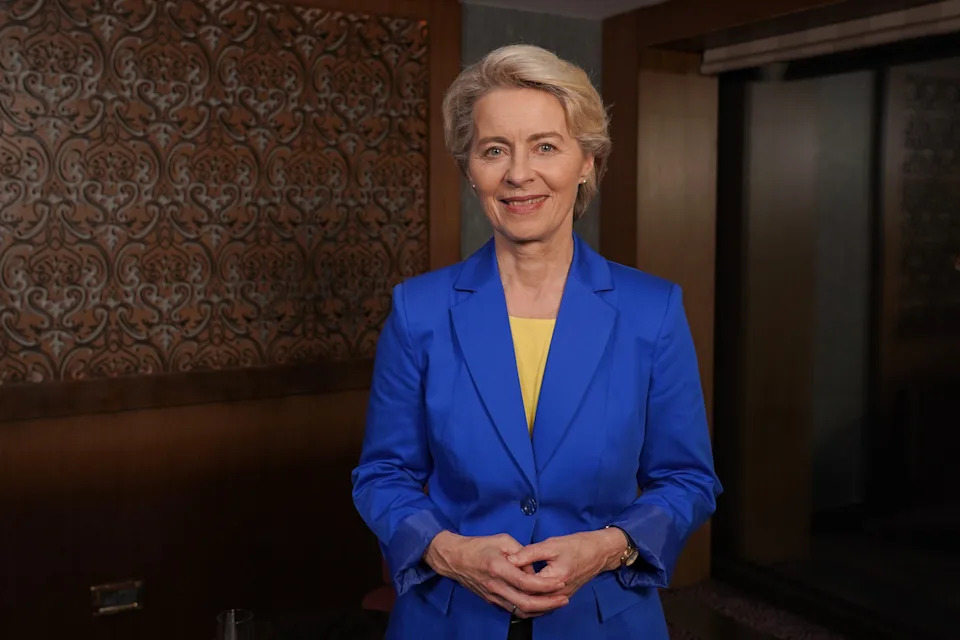

Ursula von der Leyen spent the first half of her working life treating patients, not managing institutions. She entered politics at forty-three, an age when most careers are already fixed in place. Within two decades, she was running the executive arm of the European Union, negotiating vaccine contracts worth billions of euros and setting continental policy on climate, trade, and defence.
Her path was neither linear nor especially fast at the start. It accelerated late, and it accelerated hard. Understanding how a physician from a farming family near Hanover ended up as the first woman to lead the European Commission means starting well before Brussels, in a household that treated politics as a family trade.
Family Background and Early Life of Ursula von der Leyen
See also: http://Novaline.com.ng
Claudia Sheinbaum: The Scientist Who Became Mexico’s First Woman President
Ursula Gertrud Albrecht was born on October 8, 1958, in Ixelles, a district of Brussels. Her father, Ernst Albrecht, was a senior official at the European Commission’s forerunner institutions before becoming Minister President of Lower Saxony. Her mother, Heidi Adele Stromeyer, came from a family with its own history in German industry and politics. Ursula grew up as one of seven siblings in a household where dinner-table conversation often turned to policy and public affairs. Her father later told her he felt a constant pull to shape and improve the country around him, a sentiment she absorbed early. The family’s comfortable, cosmopolitan upbringing in Brussels gave her early exposure to multiple languages and cultures, something that would later serve her in Brussels again, this time as an adult.
In 1971, when Ursula was thirteen, the Albrecht family relocated to Lower Saxony after her father entered German state politics. The move from an international, multilingual environment to a smaller German town was, by her own account, an adjustment. It also placed her squarely in the region she would go on to represent politically three decades later.
Education Across Three Countries
Von der Leyen finished her Abitur at Lehrte High School in 1976, specialising in mathematics and science. She then enrolled to study economics at the University of Göttingen in 1977, later continuing her studies at the University of Münster.
A Detour to London
In 1978, she spent time at the London School of Economics, taking the General Course in economics. She has since described the experience as eye-opening, exposing her to a multicultural society unlike anything she had encountered in Germany or Belgium. That period abroad, brief as it was, appears to have widened her outlook well beyond the family estate near Hanover.
Switching to Medicine
Economics did not hold her permanently. Wanting work that involved more direct contact with people, she switched fields and enrolled at Hannover Medical School in 1980. She trained there for seven years, graduated in 1987, and went on to earn a doctorate in medicine in 1991, specialising in women’s health and gynaecology.
Marriage, Motherhood, and a Pause From Public Life
She married Heiko von der Leyen, a fellow physician, in 1986. Between 1987 and 1999, the couple had seven children. When her husband accepted an academic post at Stanford University in the early 1990s, the family relocated to California, and von der Leyen set aside her medical career to raise their young children. That period, often summarised in a single sentence in shorter profiles, spanned roughly four years. She returned to Germany in 1996 and resumed academic work at Hannover Medical School, eventually completing a master’s degree in public health in 2001. The gap between her medical training and her political debut was long by conventional career standards, though it left her with a household of seven children and a public health credential that would later shape her policy instincts.
Entering Politics in Lower Saxony
Von der Leyen joined the Christian Democratic Union in 1990, partly in response to her father’s electoral defeat that year. For much of the 1990s, she worked in local party roles rather than elected office, serving on committees dealing with social policy and public health in the Hanover region. Her formal political career began in 2003, when she won a seat in the Lower Saxony state parliament. She was appointed the state’s Minister for Social Affairs, Women, Family, and Health almost immediately, a portfolio that mapped closely onto her medical background and her years focused on family life.
Federal Government: 2005 to 2013
After the CDU’s victory in the 2005 federal election, Chancellor Angela Merkel brought von der Leyen into her cabinet as Minister of Family Affairs, Senior Citizens, Women, and Youth. She used the post to push parental leave reform and expand childcare provision, positions that put her at odds with more socially conservative members of her own party. In 2009, she moved to the Ministry of Labour and Social Affairs. There, she pursued a mandatory quota for women on the supervisory boards of major German companies, a policy that would not pass into law until years later but established her as a persistent advocate for gender balance in corporate leadership. Colleagues at the time noted her willingness to pick fights that other ministers avoided.
Minister of Defence: A Difficult Assignment
In 2013, Merkel appointed her Minister of Defence, making her the first woman to hold the post in German history. The role proved to be the most turbulent of her domestic career.
The Consultant Affair
Her ministry came under sustained scrutiny for its use of external consultants, including major firms such as McKinsey and Accenture, to help manage defence procurement. Investigators later found that roughly €150 million had gone to outside consultants, much of it without following standard tender procedures. A parliamentary committee examined the matter closely; it stopped short of establishing criminal wrongdoing but was sharply critical of the ministry’s chaotic management under her watch.
The Gorch Fock and Readiness Concerns
Separately, the renovation of the Gorch Fock, a naval training ship, ballooned from an estimated $11.6 million to more than $160 million by the time she left the ministry in 2019. Reports during the same period also revealed that Germany’s armed forces suffered from serious equipment shortfalls, including tanks, helicopters, and aircraft that were not fully operational. Her six years at the ministry left her simultaneously praised for raising defence spending and criticised for how that spending was managed.
The Road to Brussels
By 2019, von der Leyen was a familiar figure in Berlin but not an obvious candidate for the EU’s top job. European leaders, deadlocked over other nominees, settled on her as a compromise candidate for the presidency of the European Commission. The European Parliament confirmed her by a narrow margin in July 2019, and she took office that December as the first woman to hold the position.
First Term: Pandemic, Vaccines, and the Green Deal
Her early agenda centred on the European Green Deal, an ambitious plan to make the EU climate-neutral by 2050. Within months, however, the COVID-19 pandemic reshaped her presidency almost entirely. Von der Leyen took a direct role in negotiating vaccine procurement for the bloc, including a deal securing 1.8 billion doses of the Pfizer-BioNTech vaccine. She later told journalists that the agreement had come together through personal calls and text exchanges with Pfizer chief executive Albert Bourla. That disclosure, intended to illustrate decisive leadership during a crisis, would resurface years later as a serious liability.
Pfizergate: A Transparency Dispute That Would Not Go Away
In 2021, a New York Times report on the Pfizer negotiations prompted a formal request for access to the text messages between von der Leyen and Bourla. The Commission refused, arguing it did not possess the messages in a form covered by EU transparency law. That refusal became the seed of a long-running dispute known in Brussels as Pfizergate. In May 2025, the EU’s General Court ruled against the Commission on every count, finding that it had failed to give a plausible explanation for why the messages could not be located. Anti-corruption groups called the ruling a landmark for institutional transparency. The Commission said it would review the judgment, though the content of the original messages has never been made public. The episode has continued to shadow her second term, cited by critics as evidence of a governing style some describe as insular.
A Second Term, Narrowly Won
Von der Leyen was re-elected Commission President in July 2024, receiving 401 votes in a Parliament that required 360 for confirmation. Her new mandate began in December 2024 alongside a fresh College of Commissioners, with priorities built around European competitiveness, defence readiness, and continued support for Ukraine. The second term has been more contentious than the first.
In October 2025, she faced two separate no-confidence motions in Parliament, filed by lawmakers critical of her handling of trade negotiations with the United States and the EU-Mercosur agreement. Both motions failed, largely on the strength of centrist support, though the votes signalled growing friction with segments of the chamber that once backed her comfortably. Through 2026, von der Leyen has continued positioning the Commission around what she calls European independence, framing it as a response to shifting global alliances and pressure from Washington and Moscow alike. At the World Economic Forum in Davos in January 2026, she outlined a €90 billion loan package to Ukraine for 2026 and 2027, tied to the use of immobilised Russian assets, while reaffirming the EU’s commitment to Ukraine’s long-term security.
Leadership Style
Colleagues and critics tend to agree on one point: von der Leyen keeps her circle small and her decision-making centralised. Supporters describe this as decisiveness under pressure, pointing to her handling of the vaccine rollout and rapid EU response to Russia’s invasion of Ukraine. Detractors describe the same trait as secrecy, citing both the consultant affair in Berlin and the withheld Pfizer texts in Brussels as examples of an instinct to manage information tightly rather than share it. Her medical background surfaces often in how she frames policy, favouring diagnosis-and-treatment language over ideological appeals. That approach has helped her build coalitions across a fractured European Parliament, even as it has occasionally frustrated allies looking for firmer ideological commitments.
Personal Life of Ursula von der Leyen
Von der Leyen and her husband, Heiko, have seven children, born between 1987 and 1999. The family lives on a farm near Hanover, where she keeps horses and rides regularly, one of few hobbies she has spoken about publicly. She is a native speaker of German and French and fluent in English, a trilingual fluency shaped by her Brussels childhood and later studies in London. She has generally kept her family out of public view, granting few interviews that touch on her children or home life. What has emerged suggests a household run with the same organisational discipline she has applied to her ministries and, later, the Commission itself.
Legacy and Historical Significance
Von der Leyen occupies an unusual place in European political history. She is the first woman to lead both the German defence ministry and the European Commission, breaking barriers in two of the continent’s most male-dominated institutions within a single career. Her tenure has coincided with a pandemic, a war on Europe’s border, and a period of open questioning about the EU’s global standing, giving her more crisis-management experience than most of her predecessors combined. That record is genuinely mixed. The vaccine procurement effort, despite the controversy over its documentation, is widely credited with securing supplies for 27 member states faster than most individual governments could have managed alone. The consultant affair and Pfizergate, on the other hand, have left durable questions about how she handles institutional transparency when scrutiny becomes inconvenient. Historians assessing her Commission presidency will likely weigh both strands rather than settling on one.
Frequently Asked Questions About Ursula von der Leyen
When was Ursula von der Leyen born?
She was born on October 8, 1958, in Ixelles, Brussels, to German politician Ernst Albrecht and Heidi Adele Stromeyer.
What did Ursula von der Leyen study before entering politics?
She studied economics at the universities of Göttingen and Münster and at the London School of Economics. Later she switched to medicine and did her training at Hannover Medical School and earning a doctorate in 1991.
What positions did Ursula von der Leyen hold in the German government?
Between 2005 and 2019, she served as Federal Minister of Family Affairs, Senior Citizens, Women and Youth. Also the Minister of Labour and Social Affairs, and finally Minister of Defence. She became the first woman to hold that post.
What is Pfizergate?
It refers to the dispute over text messages exchanged between von der Leyen and Pfizer chief executive Albert Bourla. This was during 2021 vaccine negotiations, which the European Commission refused to disclose. In May 2025, an EU court ruled the Commission’s refusal unlawful.
Is Ursula von der Leyen serving her first or second term as Commission President?
She is serving her second term. She was first elected in July 2019 and re-elected by the European Parliament in July 2024. Her new mandate began in December 2024.